

If a medication has ever barely worked for you or hit you with side effects at a normal dose, part of the answer may be written into your genes. Pharmacogenomics (PGx) testing looks at genes tied to how your body absorbs, breaks down, and clears medications, turning that into information your prescriber can use. It’s a simple cheek swab, not a blood draw, and one test can cover 240+ FDA-labeled medications.
At Uptown Pharmacy, our licensed pharmacists offer PGx testing alongside medication therapy management, so a genetic report becomes a conversation, not a document you’re left to interpret alone.
What Is Pharmacogenomics (PGx) Testing, Exactly?
Pharmacogenomics (PGx) testing analyzes a targeted set of genes known to affect how medications are absorbed, metabolized, and cleared from your body. Rather than screening your entire genome, a PGx panel focuses mainly on the cytochrome P450 (CYP450) family of liver enzymes, which process most prescription drugs.
Results show whether you process a medication at a typical, faster, or slower than average rate, information your prescriber can weigh alongside your symptoms and health history. The FDA keeps a running table of medications carrying pharmacogenomic information on the label, and that list grows most years.
How Is PGx Different From Pharmacogenetics or Predisposition Tests?
Pharmacogenomics and pharmacogenetics get used interchangeably, and for everyday purposes, that’s fine. Pharmacogenetics technically refers to one gene’s effect on one drug, while pharmacogenomics covers many genes and medications at once, which is what most commercial panels test.
A distinction that matters more: PGx testing is not a predisposition test. It won’t tell you your risk of cancer, heart disease, or Alzheimer’s, and it isn’t an ancestry or wellness DNA kit. A PGx test answers one narrow question: how might your body handle specific medications, nothing broader.
How Does a PGx Test Actually Work?
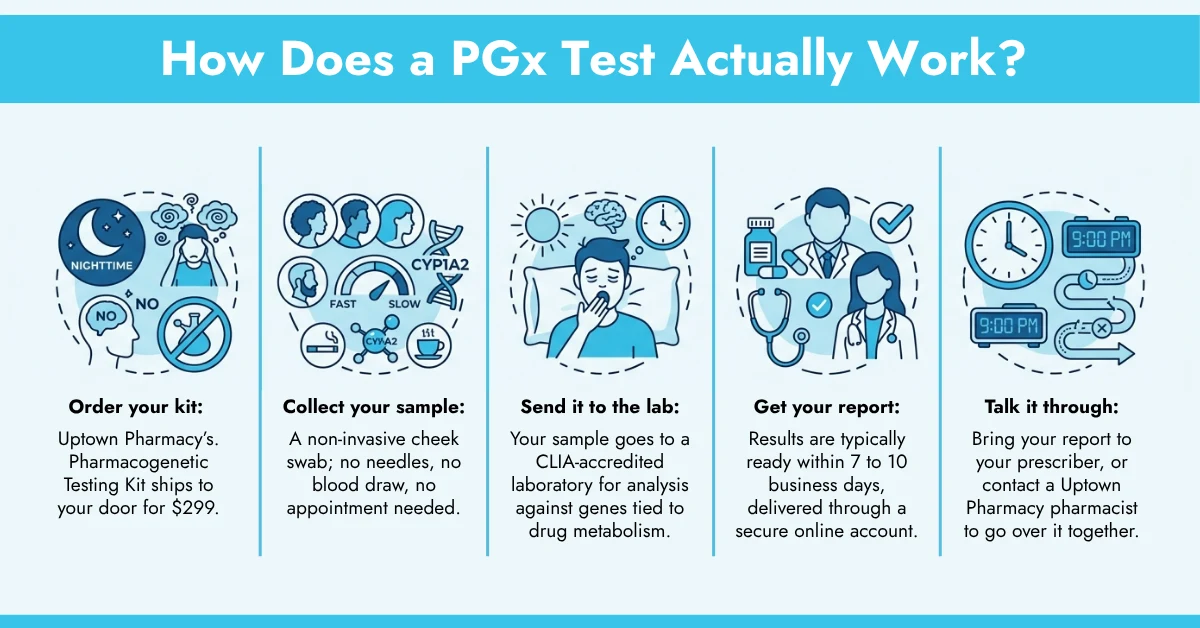
A PGx test takes five simple steps, from a swab at your kitchen table to a report you can bring to your prescriber.
- Order your kit: Uptown Pharmacy’s Pharmacogenetic Testing Kit ships to your door for $299.
- Collect your sample: A non-invasive cheek swab; no needles, no blood draw, no appointment needed.
- Send it to the lab: Your sample goes to a CLIA-accredited laboratory for analysis against genes tied to drug metabolism.
- Get your report: Results are typically ready within 7 to 10 business days, delivered through a secure online account.
- Talk it through: Bring your report to your prescriber, or contact a Uptown Pharmacy pharmacist to go over it together.
It’s a one-time test; your genotype doesn’t change, though the guidance built around it keeps growing as research continues.
Who Should Consider Pharmacogenetic Testing?
PGx testing tends to matter most for people who have already run into medication trial-and-error, rather than someone filling a first prescription with no history yet. Consider testing if you:
- Have dealt with treatment-resistant depression, anxiety, or OCD despite trying more than one medication.
- Take several prescriptions at once (polypharmacy), which raises the odds of an unnoticed gene-drug interaction.
- Have had unexpected or severe side effects at a normal, doctor-approved dose.
- Are you about to start a new psychiatric medication, pain medication, or blood thinner?
- Are you a caregiver trying to understand why a family member’s medication isn’t working?
Testing can still be worthwhile as a one-time reference for future prescriptions, even if none of these apply right now.
Which Medications and Conditions Does PGx Testing Cover?
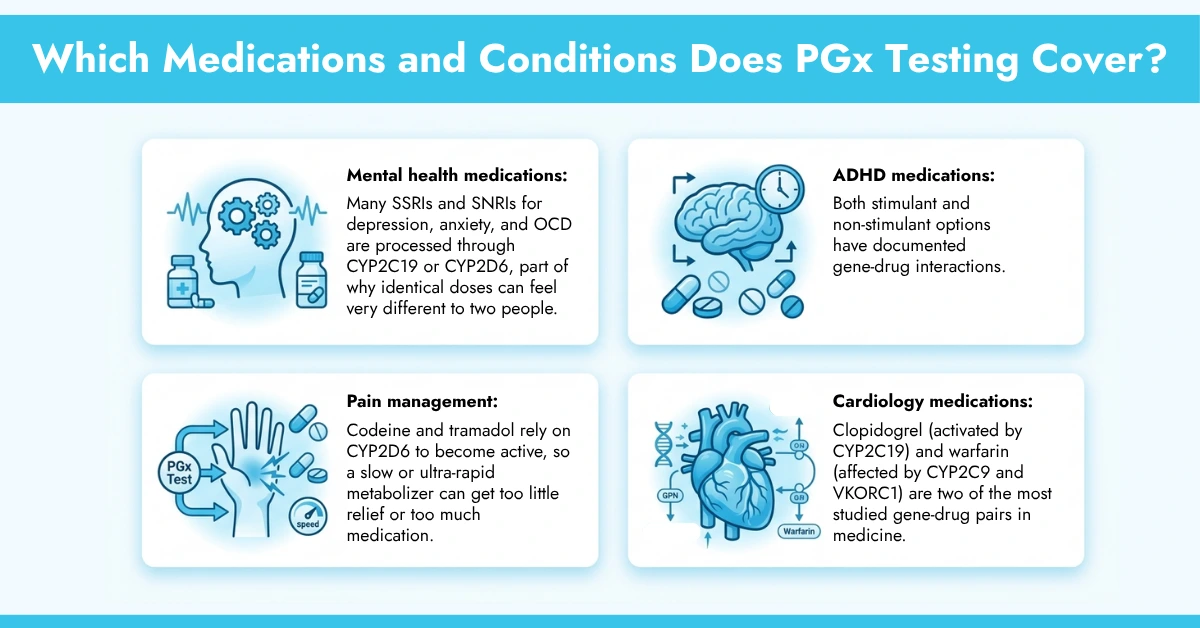
A single panel, like the one Uptown Pharmacy offers, can screen for gene variants tied to 240+ FDA-labeled medications across several categories:
- Mental health medications: Many SSRIs and SNRIs for depression, anxiety, and OCD are processed through CYP2C19 or CYP2D6, part of why identical doses can feel very different to two people.
- ADHD medications: Both stimulant and non-stimulant options have documented gene-drug interactions.
- Pain management: Codeine and tramadol rely on CYP2D6 to become active, so a slow or ultra-rapid metabolizer can get too little relief or too much medication.
- Cardiology medications: Clopidogrel (activated by CYP2C19) and warfarin (affected by CYP2C9 and VKORC1) are two of the most studied gene-drug pairs in medicine.
A PGx test covers medication response for these categories, not a diagnosis of the conditions themselves.
What Do Your Results Mean, and What Are the Limits of PGx Testing?
Your report will typically describe you as a poor, intermediate, normal, rapid, or ultra-rapid metabolizer for each gene tested, your genotype (genetic code) translated into a phenotype (what it means for how a drug behaves in your body). A poor metabolizer may build up a medication faster than it clears, raising side-effect risk at a standard dose; an ultra-rapid metabolizer may clear a drug so fast it never reaches a working level.
PGx testing explains part of the picture, not all of it. Age, kidney and liver function, other medications, alcohol use, and diet all shape how a drug behaves in your body. NIH’s National Human Genome Research Institute is direct about this: Genetics is one input among several, not a stand-alone answer. Nobody should add, stop, or change a dose based on a PGx report without a prescriber or pharmacist reviewing it.
What Happens After Your PGx Results Come Back at Uptown Pharmacy?
At Uptown Pharmacy, your report doesn’t stop at a PDF in your inbox; a licensed pharmacist reviews it with you and helps translate it into a next step with your prescriber.
- Our pharmacists can walk through your report with you, at our Dallas location or by phone.
- If your genotype points to an unusual metabolizer status and your prescriber wants a strength or form that isn’t sold commercially, our compounding pharmacy team can discuss a custom-compounded option.
- Your results can feed into a broader Medication Therapy Management review if you’re managing several prescriptions at once.
Conclusion:
Pharmacogenomics (PGx) testing helps take the guesswork out of medication therapy by showing how your genes may influence your response to many prescription drugs. While it doesn’t replace your healthcare provider’s judgment, it gives your prescriber and pharmacist valuable information to make more informed decisions about medication selection and dosing. Because your genetic makeup doesn’t change, a single PGx test can continue to support future treatment decisions for years to come.
A PGx report can’t rewrite your prescription by itself, but it can turn medication guesswork into a real conversation with someone qualified to act on it.
New to Uptown Pharmacy? Set up your new patient profile here.
Disclaimer:
This article is for general education and isn’t a substitute for individual medical or genetic counseling. Talk with your prescriber or a Uptown Pharmacy pharmacist before changing any medication.


