

Most weight-loss content promises a number: Drop 10 pounds in a week, finish a 10-day cleanse, hit a deadline before an event. The research on what actually keeps weight off tells a different story; it comes down to a short list of daily habits, repeated for months, not a single dramatic reset.
This guide covers what long-term weight management actually looks like: Safe calorie ranges, why the scale stalls, which trends hold up to evidence, and where a pharmacist fits into your plan. Uptown Pharmacy’s team works with Dallas patients on exactly this question every week.
What Does Long-Term Weight Management Really Mean?
Long-term weight management means working toward a healthy weight at a pace you can maintain while building eating, activity, sleep, and other habits that fit your everyday life.
A commonly recommended weight-loss pace is about 1-2 pounds per week, although the right pace can vary from person to person. Losing weight gradually may make it easier to maintain the loss over time. Even a modest loss of 5%-10% of your starting body weight can provide health benefits for people who have overweight or obesity.
Signs you’re on a pace that will hold:
- You can still eat this way at a restaurant, on a trip, or during a busy week.
- Meals include foods you enjoy, not only “allowed” foods.
- Sleep and energy stay steady instead of crashing.
- Progress gets measured in months, not days.
Extreme plans can produce a fast number on the scale, but most of that early drop is water and glycogen, not fat. The CDC notes that people who lose weight gradually are more likely to keep it off than people who lose it quickly and even a modest loss of 5-10% of body weight is linked to real improvements in blood pressure and blood sugar. You don’t need a dramatic number to see a health benefit.
How Many Calories Do You Actually Need?
There’s no single correct calorie number for everyone it depends on your age, sex, height, activity level, muscle mass, and any medications you take. What matters is your net calories: what you eat and drink, minus what your body uses in a day.
Rather than copying a stranger’s meal plan, the NIH Body Weight Planner is a free tool that estimates a starting point from your own numbers.
A few things shift that number more than people expect:
- Muscle mass (more muscle burns more at rest).
- Thyroid function and other weight loss resistance factors.
- Sleep debt.
- Certain prescriptions, some antidepressants, steroids, and diabetes medications affect appetite or weight.
Very low-calorie diets (under roughly 800 calories a day) belong under a doctor’s supervision, not a self-directed plan. If your weight has shifted since starting a new prescription, a Medication Therapy Management (MTM) review at Uptown Pharmacy checks whether a medication is part of the pattern. Some people count macros instead of calories for the same reason; it shows the fuller picture, not just one number.
Why Does Weight Loss Slow Down or Stop?
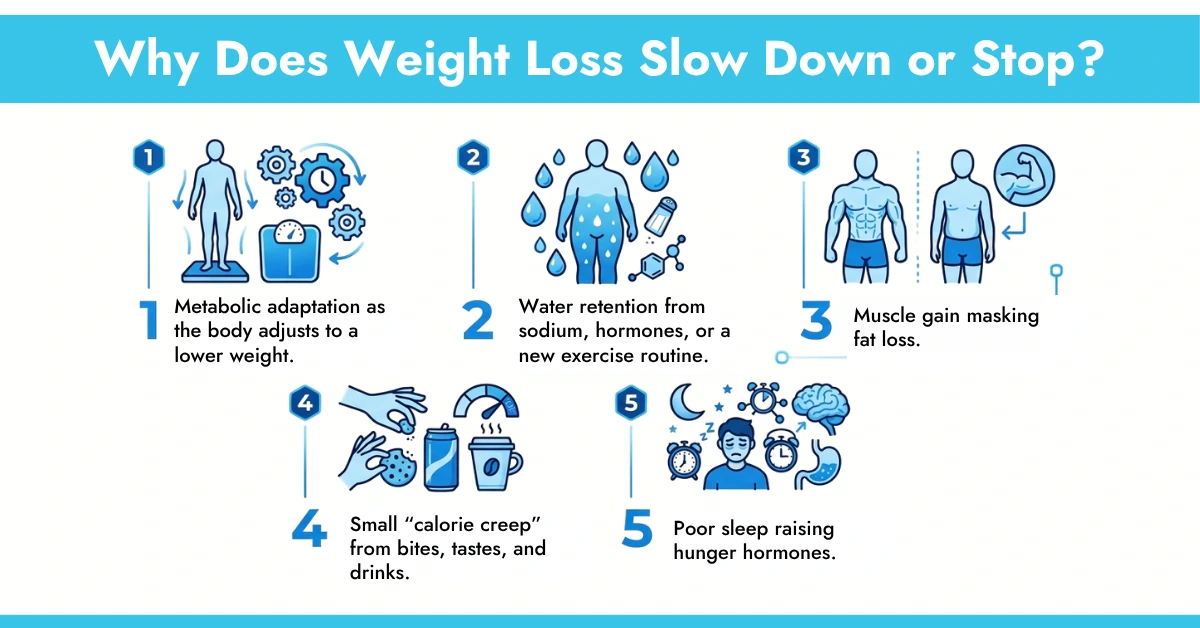
A weight loss plateau happens because a lighter body needs fewer calories to run, so the eating pattern that worked at a higher weight stops creating a deficit. The scale can also sit still while body composition keeps changing underneath it.
Common causes:
- Metabolic adaptation as the body adjusts to a lower weight.
- Water retention from sodium, hormones, or a new exercise routine.
- Muscle gain masking fat loss.
- Small “calorie creep” from bites, tastes, and drinks.
- Poor sleep raising hunger hormones.
A quick way to see real change: divide pounds lost by your starting weight (15 pounds lost from a 200-pound start is 7.5%). For a fuller picture, Uptown Pharmacy’s InBody 570 Body Composition Scan ($10 per scan) breaks progress into muscle mass, fat percentage, and water balance, so a flat week on the scale doesn’t erase real change happening underneath it.
Which Daily Habits Make the Biggest Difference?
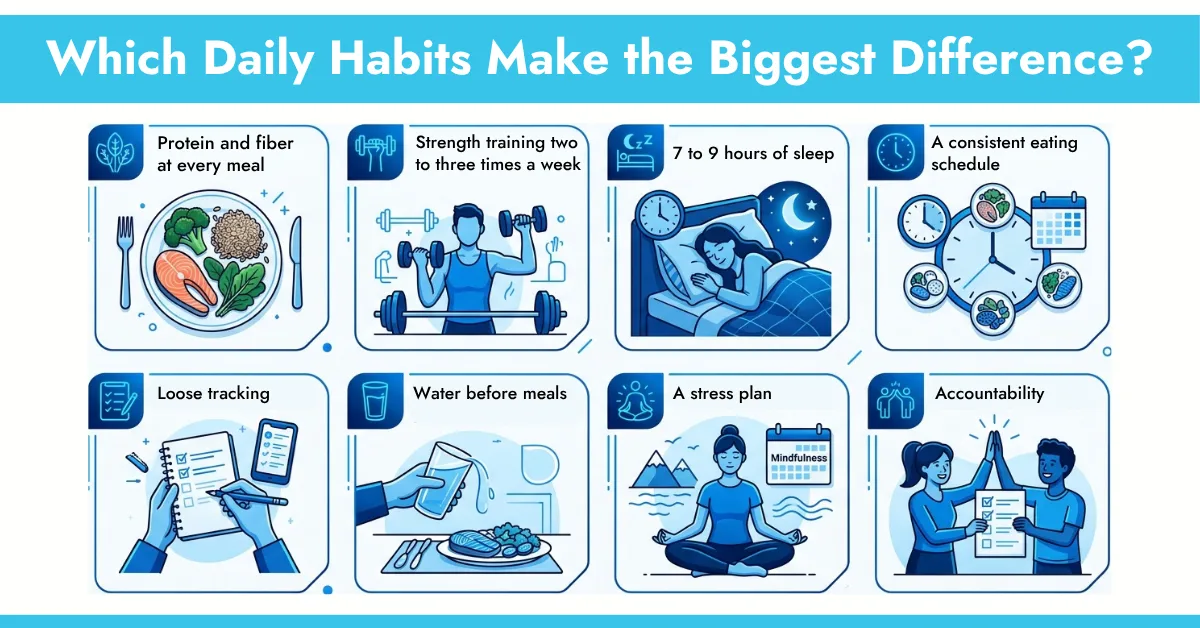
The habits with the strongest evidence behind them are simple and repeatable: Enough protein and fiber, regular movement, consistent sleep, and a plan for meals before hunger takes over. None of them require a special product or a 10-day reset.
- Protein and fiber at every meal: Both slow digestion and blunt the swings that lead to snacking.
- Strength training two to three times a week: This protects the muscle that keeps resting metabolism from dropping as you lose weight.
- 7 to 9 hours of sleep: Short sleep raises ghrelin (the hunger hormone) and lowers leptin (the fullness hormone); a real digital detox, screens off an hour before bed, does more here than most supplements.
- A consistent eating schedule: Skipping meals to save calories usually backfires by evening.
- Loose tracking: A habit tracker, a weight-tracking app, or a simple food log catches patterns memory alone will miss.
- Water before meals: Thirst gets mistaken for hunger more often than people expect.
- A stress plan: Cortisol spikes are tied to cravings for high-calorie foods; a short walk or five quiet minutes before eating cuts down on stress-driven bites.
- Accountability: A friend, a support group, or a structured weight loss challenge with clear rules keeps habits steady when motivation dips.
Do Detoxes, Cleanses, or Apple Cider Vinegar Actually Work?
No cleanse, tea, or detox kit removes anything your liver and kidneys weren’t already clearing. Apple cider vinegar has only weak, inconsistent evidence for weight loss in human studies, and neither replaces the habits above.
Approach | Typical pace | Sustainable long-term? | Why |
Very low-calorie “crash” diet | Fast, short-term | Rarely | Mostly water and muscle loss; often regained |
10-day detox or cleanse | Fast (temporary) | No | No proven toxin-removal benefit |
Extended water fasting | Fast | Only with supervision | Risky for diabetes without a provider involved |
Steady deficit + daily habits | ~1-2 lb/week | Yes | Matches the CDC-cited safe pace |
Mayo Clinic notes that studies haven’t shown meaningful weight loss or lasting hunger control from apple cider vinegar, and that it can interact with diuretics, insulin, and other medications. A widely cited 2024 study claiming dramatic ACV weight loss was retracted in late 2025 over concerns about the research itself, as NPR reported, worth knowing if you’ve seen that study cited elsewhere. It isn’t a treatment for kidney stones, and drinking it undiluted can wear down enamel and irritate the throat over time. If you manage diabetes, skip fasts and cleanses without your provider’s sign-off, since blood sugar can swing fast on an empty stomach.
When Does Weight-Loss Effort Cross Into a Problem?
It’s worth pausing and reaching out if food, weight, or exercise starts to feel controlling; skipped meals, secretive eating, compulsive exercise, or extreme swings in weight are signs that need care, not more willpower.
This comes up often enough to deserve a direct answer, not a footnote. If it sounds familiar, for yourself or someone you love. The National Alliance for Eating Disorders provides a free, confidential helpline staffed by eating-disorder specialists and an Uptown Pharmacy pharmacist is also a normal, judgment-free place to start that conversation.
What Can an Uptown Pharmacy Pharmacist Do for Your Plan?
A pharmacist can check whether current prescriptions or supplements are working against your goals, point you toward professional-grade products instead of guesswork, and track real progress with tools most people don’t have at home.
- Medication Therapy Management: A full review of your medication list for anything tied to appetite or weight changes.
- Supplement guidance: Uptown Pharmacy carries professional lines including Pure Encapsulations, Ortho Molecular, and Metagenics; a pharmacist can explain proper use and flag interactions with what you already take. Dietary supplement statements haven’t been evaluated by the FDA and aren’t a substitute for the habits above.
- InBody 570 scan: Track muscle, fat, and water instead of only the number on the scale.
- Two-way pharmacy texting: A quick question, answered without a phone call or an office visit.
Conclusion:
Weight management that lasts comes from habits repeated on ordinary weeks, not one dramatic reset. Pick one or two changes from this list, give your body time to adjust, and bring in support when you need it; a pharmacist, a doctor, or a helpline are normal parts of that plan, not a last resort.
Talk to an Uptown Pharmacy pharmacist about a plan built around your own numbers; contact the team here.
Disclaimer:
This article is educational and isn’t personalized medical advice. Talk to your doctor or an Uptown Pharmacy pharmacist before starting a weight-management plan, especially if you’re pregnant, managing diabetes, or taking prescription medication.


