

Stand in the supplement aisle, and you’ll spot probiotics and prebiotics on bottles a few inches apart, with labels that rarely explain why you’d need one, the other, or both. Confusing the two is common; they work at different steps of the same digestive process, and grabbing the wrong one means your gut doesn’t get what it actually needs.
Below is the real difference between prebiotics and probiotics, when to take them, what’s safe, and how to pick between food, capsules, and gummies, with input from the pharmacist team at Uptown Pharmacy.
What’s the Real Difference Between Prebiotics & Probiotics?
Probiotics are live bacteria and yeasts that add more “good” microbes to your gut. Prebiotics are fiber-like compounds that feed the good bacteria already living there. One adds new workers to the job; the other feeds the ones already on shift.
|
Probiotics |
Prebiotics |
|
|
What it is |
Live bacteria and yeasts |
Fiber your body can’t digest |
|
Where it’s found |
Yogurt, kefir, sauerkraut, kimchi, supplements |
Garlic, onions, bananas, oats, chicory root, supplements |
|
What it does |
Adds good bacteria to your gut |
Feeds the bacteria already there |
|
Common examples |
Lactobacillus, Bifidobacterium, Saccharomyces boulardii |
Inulin, FOS, GOS |
Two related terms show up more often now, too. Postbiotics are made from probiotic bacteria that have been deliberately inactivated; the bacteria are no longer alive, but research shows the leftover compounds can still confer a benefit, according to the International Scientific Association for Probiotics and Prebiotics. A product combining live probiotics with prebiotic fiber is called a synbiotic, per Mayo Clinic. And probiotics aren’t the opposite of antibiotics, either, even though the names sound alike; antibiotics kill bacteria (including some of the good kind), while probiotics add more of it back.
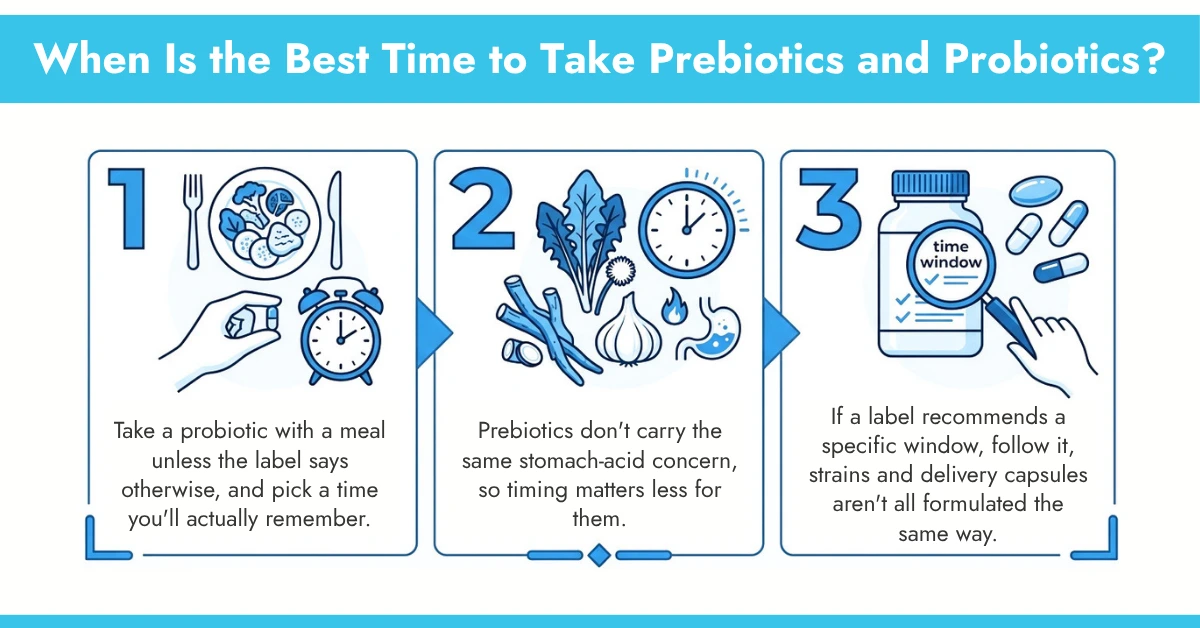
When Is the Best Time to Take Prebiotics and Probiotics?
Advice on timing is genuinely mixed. Cleveland Clinic dietitian Gail Cresci, PhD, RD, recommends taking a probiotic alongside a meal that has some fat, protein, and carbs, such as breakfast with yogurt, for example, since food buffers stomach acid before it reaches your gut. Other research points to taking it 30 minutes before eating instead.
What nearly every source agrees on: Consistency beats precise timing.
- Take a probiotic with a meal unless the label says otherwise, and pick a time you’ll actually remember.
- Prebiotics don’t carry the same stomach-acid concern, so timing matters less for them.
- If a label recommends a specific window, follow it, strains and delivery capsules aren’t all formulated the same way.
Do Probiotics & Prebiotics Make You Poop, or Cause Gas & Bloating?
Both can change your bowel movements. Some research links probiotics to more regular stools, and prebiotic fiber adds gentle bulk that can make stool easier to pass, but starting either one commonly brings a few days of gas or bloating while your gut bacteria adjust.
- Gas and bloating are most common in the first one to two weeks and typically fade as your gut adjusts.
- Prebiotic fiber, especially inulin, tends to cause more gas than probiotics, since it’s fermented directly in your colon.
- A smaller starting dose, extra water, and adding fiber gradually all shorten the adjustment period.
- Give it two to four weeks of daily use before deciding whether it’s making a real difference.
Can Prebiotics and Probiotics Affect Weight Loss or Other Health Goals?
Research links gut bacteria to metabolism and appetite, and a few specific strains have shown modest effects on weight in small studies, but prebiotics and probiotics aren’t a stand-alone weight-loss method, and the evidence so far is early. They work best as one part of a diet that already includes vegetables, fiber, and protein, not a replacement for one.
Beyond weight, some strains are studied for immune function and nutrient absorption; in simple terms, a healthier gut lining absorbs vitamins and minerals more efficiently. No supplement treats, cures, or prevents any disease, and these statements haven’t been evaluated by the FDA.
Is It Safe to Take Prebiotics and Probiotics Every Day?
For most healthy adults, daily probiotic or prebiotic use is considered safe; these aren’t medications with a strict overdose limit. A few groups should check with a doctor or pharmacist before starting either one:
- Anyone pregnant or breastfeeding.
- Anyone immunocompromised, critically ill, or recovering from surgery.
- Anyone with a central line or feeding tube.
- Parents considering a probiotic for a premature infant, talk to the baby’s pediatrician first; the FDA has flagged a real infection risk in this specific group.
Prebiotic fiber has a clearer overdose pattern: taking more than about 20 grams a day can bring cramping, gas, or diarrhea. Stick to the labeled dose or ask a pharmacist for a starting point that fits you.
Can You Take Probiotics With Other Medications?
Yes, probiotics generally mix fine with multivitamins and magnesium, with no widely reported interaction between them. Antibiotics are the common exception: they can wipe out probiotic bacteria if taken at the same time.
- Space probiotics and antibiotics at least 2 hours apart, so the antibiotic doesn’t kill the bacteria you just took.
- Multivitamins, vitamin D, and magnesium need no special timing around a probiotic.
- If you’re on several prescriptions, including immune-suppressing drugs like corticosteroids, ask a pharmacist to check the full list, not just for probiotics, but anything new you add.
Uptown Pharmacy’s Medication Therapy Management reviews go through your entire medication list at once, a solid option if you’re managing more than a couple of prescriptions.
Which Form Is Right for You: Food, Capsules, Powder, or Gummies?
Fermented foods, capsules, powders, and gummies all carry probiotics or prebiotics in different forms. The right pick depends on how precise you need the dose to be and how consistently you’ll actually take it.
Fermented foods (yogurt, kefir, sauerkraut, kimchi):
- Pros: Real nutrients like protein and calcium alongside live cultures; nothing extra to buy.
- Cons: Strains and bacteria counts aren’t listed or standardized; some brands add sugar that cancels out the upside.
Capsules and powders:
- Pros: Exact CFU (colony-forming unit) count and strain right on the label; easier to match a strain to a specific goal.
- Cons: Potency varies by brand, and some strains need refrigeration to stay alive.
Gummies:
- Pros: Easiest to remember, especially for kids or picky adults.
- Cons: Usually lower CFU counts and added sugar compared with capsules.
Uptown Pharmacy carries professional-grade lines like Pure Encapsulations and Ortho Molecular, and our pharmacists can point you toward a strain and form that actually fits your routine.
Conclusion:
Picking between prebiotics and probiotics comes down to what your gut needs: more good bacteria, more food for the bacteria you already have, or both together as a synbiotic. Start with food where you can, add a supplement where it actually makes a difference, and give your gut a few weeks before judging results.
Disclaimer:
This article is for general education and isn’t a substitute for medical advice. Talk to your doctor or an Uptown Pharmacy pharmacist before starting a new supplement, especially if you’re pregnant, nursing, immunocompromised, or on prescription medication. Supplement statements haven’t been evaluated by the FDA and aren’t intended to diagnose, treat, cure, or prevent any disease.


