

Roughly 1 to 3% of all U.S. prescriptions are compounded, meaning a licensed pharmacist customizes them for a specific patient rather than pulling from a mass-produced bottle. If you’ve been handed a compounded prescription and started wondering whether it’s actually tested, regulated, or safe, you’re asking the right question.
Short answer: Compounded medications can be very safe, but that safety depends entirely on the pharmacy preparing them, not on the drug itself. Here’s what actually determines it.
What Exactly Is a Compounded Medication?
Compounding means a pharmacist combines, mixes, or alters ingredients to create a medication built for one specific patient, something a factory-made pill or liquid can’t do. It isn’t a shortcut or an alternative-medicine practice. It’s a legally defined part of pharmacy, governed by Sections 503A and 503B of the federal Food, Drug and Cosmetic Act.
Providers typically prescribe a compounded medication when:
- The commercial version contains a dye, preservative, or filler the patient can’t tolerate.
- The needed strength or form (a liquid instead of a pill, for example) isn’t manufactured.
- The commercial product sits on the FDA’s drug shortage list.
- A child, senior, or hospice patient needs an entirely different delivery method.
Are Compounded Medications FDA-Approved?
No, and this is the most misunderstood fact in the whole topic. The FDA doesn’t test or approve individual compounded formulas the way it approves commercial drugs through a New Drug Application. That isn’t a loophole; it’s how compounding is legally structured, since these drugs are prepared in small batches for individual patients rather than mass-produced.
That doesn’t mean compounding is unregulated:
|
Compounded Medications |
FDA-Approved Commercial Drugs |
|
|
Regulatory pathway |
FD&C Act Sections 503A/503B; primarily state board oversight |
FDA New Drug or Abbreviated New Drug Application |
|
Premarket testing |
Not independently verified by FDA before dispensing |
Multi-phase clinical trials required |
|
Manufacturing standard |
USP <795>, <797>, <800>; cGMP required only for 503B facilities |
cGMP is required for every batch |
|
Built for |
One specific prescription |
Fixed strength, mass production |
|
Oversight type |
503A = patient-specific, state-licensed. 503B = “outsourcing facility,” FDA-registered |
FDA-approved from the start |
A live example worth knowing:
Compounded semaglutide and tirzepatide (the active ingredients behind popular GLP-1 medications) show exactly why this distinction matters.
Once the FDA declared the national shortages of both drugs resolved, large-scale outsourcing-facility compounding of them lost its legal basis. More recently, the FDA went a step further and proposed excluding semaglutide, tirzepatide, and liraglutide from the 503B bulk drug substances list entirely, citing no clinical need for large-scale compounding now that FDA-approved versions are widely available.
Individual, patient-specific 503A compounding can still happen under a valid prescription but copying a commercial drug “regularly or in inordinate amounts” isn’t allowed. If a compounded GLP-1 is on the table for you, ask your pharmacist about its current legal status before starting. This remains one of the fastest-moving areas in compounding regulation.
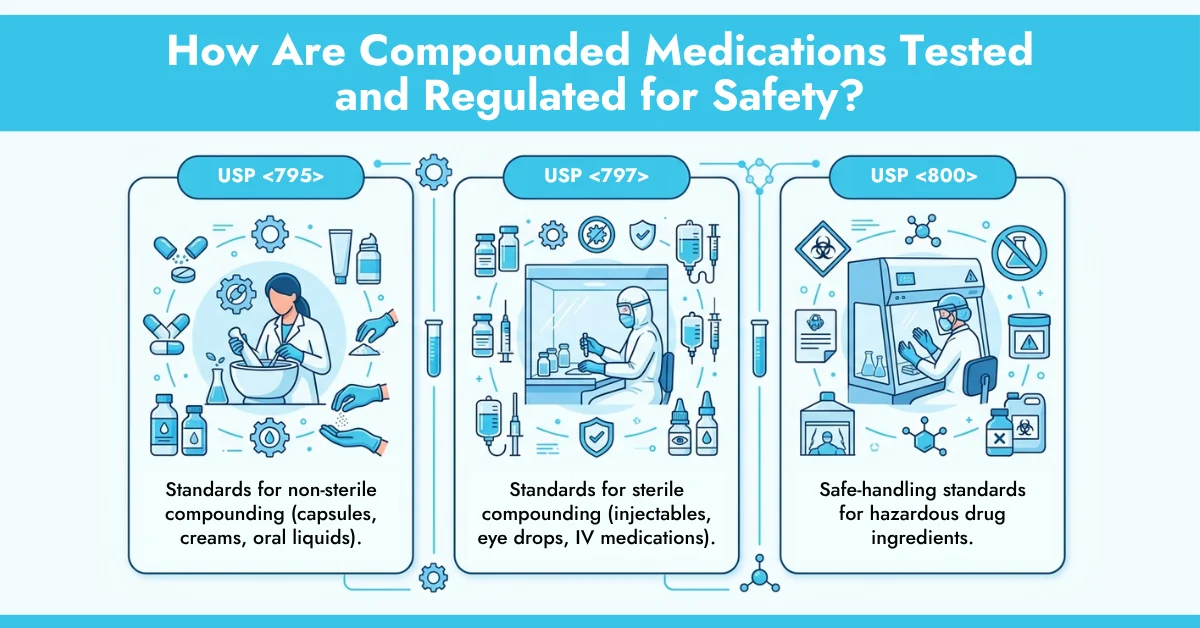
How Are Compounded Medications Tested and Regulated for Safety?
Every state Board of Pharmacy licenses and inspects compounding pharmacies as a baseline. Beyond that, quality-focused pharmacies follow:
USP <795>: Standards for non-sterile compounding (capsules, creams, oral liquids).
USP <797>: Standards for sterile compounding (injectables, eye drops, IV medications).
USP <800>: Safe-handling standards for hazardous drug ingredients.
Third-party accreditation, such as PCAB Accreditation (administered by ACHC) or NABP’s Compounding Pharmacy Accreditation, both requiring on-site inspection that goes beyond state licensing alone.
All three USP chapters have undergone major revisions and are now officially enforceable, so it’s worth asking whether a pharmacy’s practices reflect the current chapters rather than older versions.
What Are the Real Risks of Compounded Medications?
The risks are real, and glossing over them doesn’t help anyone. The most-cited cautionary example: contaminated steroid injections from a Massachusetts compounding pharmacy triggered a nationwide fungal meningitis outbreak, roughly 750 patients sickened and 64 deaths, according to the CDC. That outbreak led directly to the Drug Quality and Security Act (DQSA), which created the 503B outsourcing-facility category and significantly expanded FDA oversight of compounding nationwide.
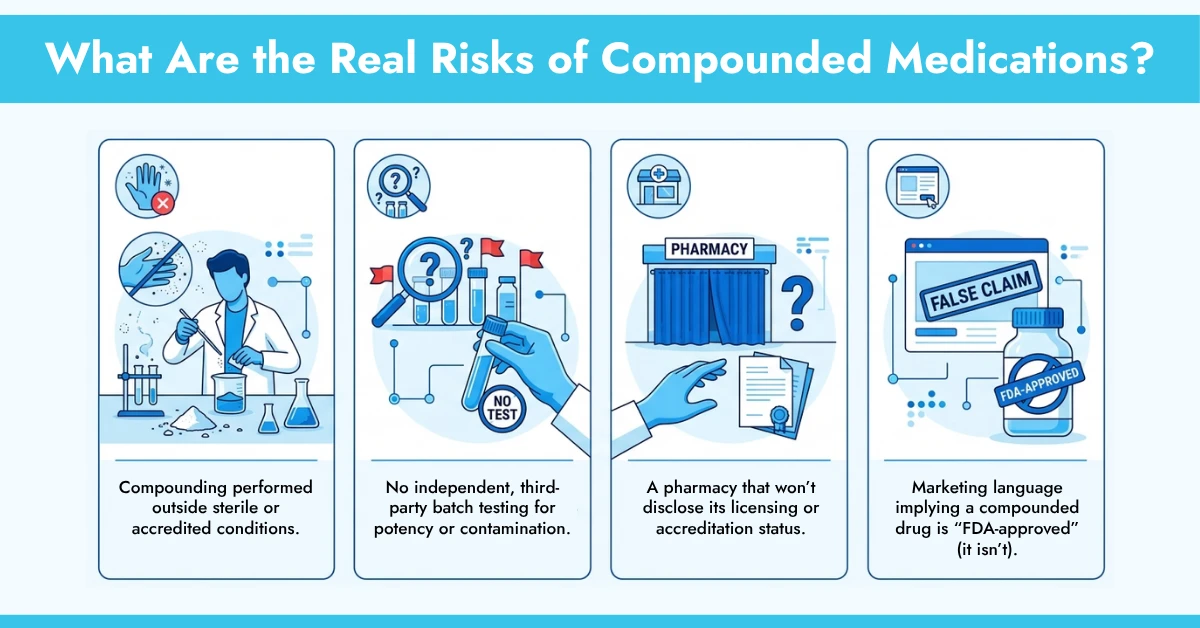
Warning signs worth watching for:
- Compounding performed outside sterile or accredited conditions.
- No independent, third-party batch testing for potency or contamination.
- A pharmacy that won’t disclose its licensing or accreditation status.
- Marketing language implying a compounded drug is “FDA-approved” (it isn’t).
Who Actually Benefits From Compounded Medications?
Compounding solves problems that commercial manufacturing structurally can’t:
- Allergies and sensitivities: Dye-free, gluten-free, or preservative-free versions of common drugs.
- Pediatric and geriatric patients: Flavored liquids or smaller doses when standard tablets don’t work.
- Hospice and palliative care: Alternative delivery routes as swallowing becomes difficult.
- Hormone therapy: Individualized, physician-supervised dosing.
- Low-dose naltrexone and similar therapies: No commercial version exists at that strength.
- Discontinued or shortage medications: Keeping patients on a therapy their regular pharmacy can’t fill.
How Can You Tell If a Compounding Pharmacy Is Trustworthy?
Ask these questions before you fill anything:
- Is the pharmacy licensed in your state, and can they show it?
- Do they hold PCAB or NABP compounding accreditation?
- Is every batch verified by an independent lab, not just self-tested?
- Is a licensed pharmacist actually reviewing your prescription, not just an intake form?
At Uptown Pharmacy, our compounding medication is built around these standards: current USP <795>/<797> practices, independent third-party batch testing before anything ships, and pharmacist review on every formulation, the same accountability you should expect from any pharmacy handling a custom prescription.
Are Compounded Medications Covered by Insurance?
It depends on the plan and the drug. Because compounded medications don’t carry a standard National Drug Code the way FDA-approved products do, many insurers require prior authorization and documented proof of medical necessity before covering them. Purely elective formulations are often cash-pay only. If cost is a concern, ask your compounding pharmacist to check your specific benefit and whether a patient assistance program applies.
Conclusion
Compounded medications aren’t inherently riskier or safer than commercial drugs; they’re simply built differently, for one patient instead of a mass production line, which shifts the safety burden from the FDA’s premarket review to the individual pharmacy’s licensing, accreditation, and quality controls. The real question isn’t “are compounded medications safe,” it’s “is this specific pharmacy following the standards that make them safe.” Ask about accreditation, batch testing, and current USP compliance before you fill anything. A pharmacy confident in its process will answer without hesitation.
Disclaimer:
At Uptown Pharmacy, we believe in full disclosure. Please note that while our medical information is researched for your education, it does not replace a doctor’s advice. Compounded medications are unique to each patient and are not FDA-approved. Additionally, to protect patient privacy while providing a visual experience, the images featured in this article are AI-generated.


