

Your doctor just mentioned a “compounded medication”, and now you’re staring at a blank screen wondering what that even means.
You’re not the only one. Thousands of patients in Dallas and across Texas search for compounding pharmacy information every month. They’re dealing with drug shortages, dye allergies, doses that don’t come in the right strength, or conditions that standard commercial drugs simply don’t address well.
This guide breaks everything down, like what you need to know about the main types of compounding pharmacy, and how Uptown Pharmacy in Dallas, TX can help.
What Is a Compounding Pharmacy?
A compounding pharmacy creates customized medications for individual patients when a standard commercial drug won’t work for them.
Think of it this way: most medications are manufactured in one size for the average person. Compounding is what happens when your body, condition, or situation isn’t average.
A licensed pharmacist may:
- Change the form: Turning a pill into a liquid, cream, or nasal spray.
- Adjust the dose: Preparing a strength that isn’t sold commercially.
- Remove an ingredient: Like a dye, gluten, or preservative you react to.
- Combine medications: Merging two therapies into one for convenience.
All compounded medications require a valid prescription from a licensed provider. They are prepared under strict USP quality standards and are not the same as generic or off-brand drugs. They are fully personalized.
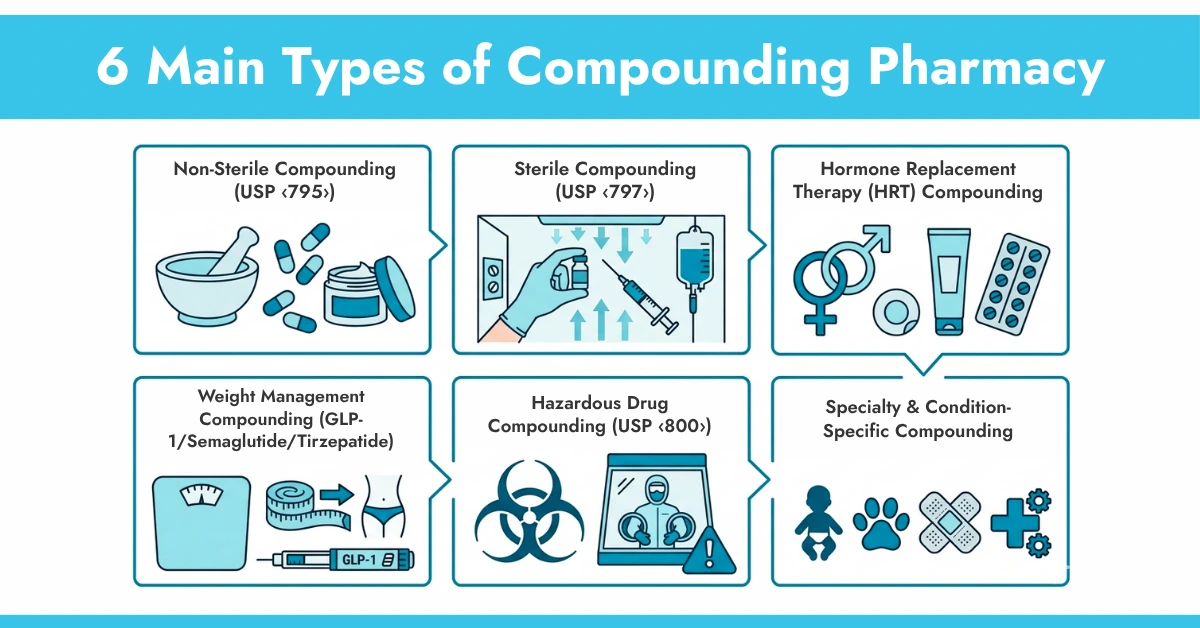
6 Main Types of Compounding Pharmacy
1. Non-Sterile Compounding (USP ‹795›)
This is the most common type of compounding. It covers any medication that doesn’t need to be completely free of microorganisms, because it isn’t injected or placed directly in the eye.
Who it’s for:
- Patients allergic to commercial dyes, fillers, or preservatives.
- Children who need flavored liquids instead of tablets.
- Adults needing custom-strength topical creams.
- Anyone requiring a dose or form not available commercially.
Common examples include:
Custom-strength capsules and oral tablets.
- Topical pain relief and hormone creams.
- Flavored liquid suspensions for children and pets.
- Compounded ivermectin or mebendazole in weight-specific doses.
Non-sterile compounds are often ready within 1-2 business days and are the most accessible form of compounding for everyday patients.
2. Sterile Compounding (USP ‹797›)
Sterile compounding covers medications that go directly into the body, through injection, IV infusion, or the eyes. These preparations must be completely free of any bacteria or contaminants, which is why they require specialized cleanrooms and strict protocols.
Who it’s for:
- Patients receiving injectable hormone therapies.
- Anyone needing sterile eye drops after surgery or for chronic conditions.
- Patients using IV infusion therapies or peptide injections.
Common examples include:
- Preservative-free sterile eye drops.
- Injectable testosterone, progesterone, or peptides.
- Compounded NAD+ infusions.
- Custom IV preparations.
Sterile compounding is more complex and requires facilities with ISO-classified cleanrooms, gowning protocols, and staff testing. Not all pharmacies are licensed to compound sterile preparations; always verify.
3. Hormone Replacement Therapy (HRT) Compounding
Compounded HRT is one of the most in-demand services at Uptown Pharmacy and one of the most misunderstood.
Standard commercial hormone products come in fixed doses designed for an average patient. Compounded HRT is built around your lab results, your symptoms, and your prescriber’s recommendations.
For women, compounded HRT commonly addresses:
- Perimenopause and menopause symptoms (hot flashes, sleep disruption, mood changes).
- Estrogen, progesterone, and testosterone imbalances.
- Conditions where commercial HRT doses are too strong or too weak.
For men, it commonly covers:
- Low testosterone and the symptoms that come with it: fatigue, brain fog, low mood.
- Thyroid and adrenal support.
- Customized dosing for testosterone replacement therapy.
Available forms include: Creams, capsules, troches, injections, and vaginal preparations, whichever form your prescriber determines is best for you.
Compounded HRT is sometimes called bioidentical hormone therapy (BHRT). These hormones are structurally identical to what your body naturally produces, customized to match your individual biology.
4. Weight Management Compounding (GLP-1/Semaglutide/Tirzepatide)
Weight management compounding has become one of the most searched topics in pharmacy in 2026. Medications like semaglutide (the active ingredient in Ozempic and Wegovy) and tirzepatide (Mounjaro/Zepbound) are in high demand, but commercial versions are expensive and haven’t always been available in the doses patients need.
Compounded versions allow prescribers to:
- Customize the dose titration starting low and adjusting gradually to reduce side effects.
- Address individual tolerability; some patients respond better to modified formulations.
- Fill gaps when commercial products are unavailable or unaffordable.
Important 2026 note: FDA enforcement around compounded GLP-1 medications tightened significantly in 2025-2026. At Uptown Pharmacy, all weight management compounds require a valid prescription and are prepared under current compliance standards. Speak directly with our pharmacists about current availability.
5. Hazardous Drug Compounding (USP ‹800›)
The name sounds alarming, but USP ‹800› is about protecting pharmacy staff, not about the medication being dangerous to patients.
Certain drugs require special handling during preparation because of their chemical properties. These include some hormone therapies, low-dose naltrexone (LDN), and select specialty medications.
What USP ‹800› actually means for you:
- Your medication is prepared in a negative-pressure room.
- Staff use closed-system transfer devices and protective equipment.
- The formulation you receive is the same; the safety protocols are for the people preparing it.
6. Specialty & Condition-Specific Compounding
This covers the wide range of customized medications for specific conditions where commercial options fall short. It’s one of the areas where compounding pharmacy adds the most value for everyday patients.
At Uptown Pharmacy, specialty compounding covers 20+ therapy areas:
- Pediatric compounding: Flavored liquids and precise doses for children.
- Dermatology: Custom topicals for acne, hyperpigmentation, eczema, and wound care.
- Pain management: Anti-inflammatory and analgesic topical compounds.
- Brain health: Cognitive support and neuroprotective formulations.
- Hair loss therapy: Compounded finasteride, minoxidil, and DHT-blocking blends.
- Dental: Anesthetics and antimicrobials for dental procedures.
- Ophthalmics: Preservative-free sterile eye preparations.
- Gut health: Microbiome and gastrointestinal support formulations.
- Veterinary: Flavored, precisely dosed medications for pets.
- Mental health: Mood-balancing and anxiety-support compounds.
- Sexual wellness: Discreet compounded therapies for men and women.
- Sports medicine: Recovery and anti-inflammatory compounds.
- Immune support: Targeted immune modulation therapies.
How to Verify a Compounding Pharmacy Is Legitimate
Not every pharmacy that claims to compound medications meets the same safety standards. Before you fill a compounded prescription anywhere, check for these:
- Valid state Board of Pharmacy compounding license.
- USP ‹795›, ‹797›, or ‹800› compliance (matching what they prepare).
- LegitScript Certification (Uptown Pharmacy is LegitScript Certified).
- Pharmacist review on every prescription before dispensing.
- Transparent ingredient sourcing available on request.
- Clear beyond-use dating on all preparations.
- Published NPI (Uptown Pharmacy NPI: 1669962569).
A legitimate compounding pharmacy will always answer your compliance questions openly and without hesitation.
Conclusion
Pharmacy compounding remains one of the most personalized tools available in modern medicine. Whether you need a custom-strength hormone preparation, a flavored pediatric liquid, a sterile injectable, or a specialty compound for a condition that standard products don’t address well, the right compounding pharmacy makes the difference between a medication that fits your life and one that doesn’t.
At Uptown Pharmacy in Dallas, TX, our LegitScript-Certified pharmacists bring clinical expertise and genuine patient focus to every compound we prepare. If you have a prescription that needs a personalized approach, or simply want to understand your options, we’re here to help.


