

What is dermatology compounding? A pharmacist makes a medication by hand for one patient, working from a prescription, instead of selling a manufactured box off a shelf. If your dermatologist just sent over an order like that, the word on your label probably arrived with no explanation. Fair enough. Four minutes here, and you’ll know what to ask before you pay.
What Is Dermatology Compounding, and Who Makes It?
Your prescriber writes the ingredients, the strength, and the form on a prescription. A pharmacist measures those ingredients, mixes them, and labels the batch. It’s yours and nobody else’s, and nothing goes back on a shelf for the next customer.
We make these in Dallas, and our dermatology compounding service covers everything from acne formulas to scalp preparations.
What Compounded Dermatology Medications Look Like
Compounded dermatology medications arrive as creams, ointments, gels, lotions, foams, liquids, or medicated shampoos. The form isn’t a small detail. A foam spreads across a hairy scalp without tugging at it. An ointment stays where you put it on a cracked heel. A light gel suits an oily face better than a heavy cream does.
Two things catch people off guard. Compounded doesn’t mean generic, a generic is a tested copy of a brand-name drug, while a compound is made once for one person. And you can’t buy it without a prescription. Not from us, not from anyone, whatever a website promises.
Scalp and hair problems come through our door constantly. If thinning hair brought you here, our post on male pattern baldness covers the stages and what doctors reach for.
Why Your Prescriber Writes a Compounded Formula
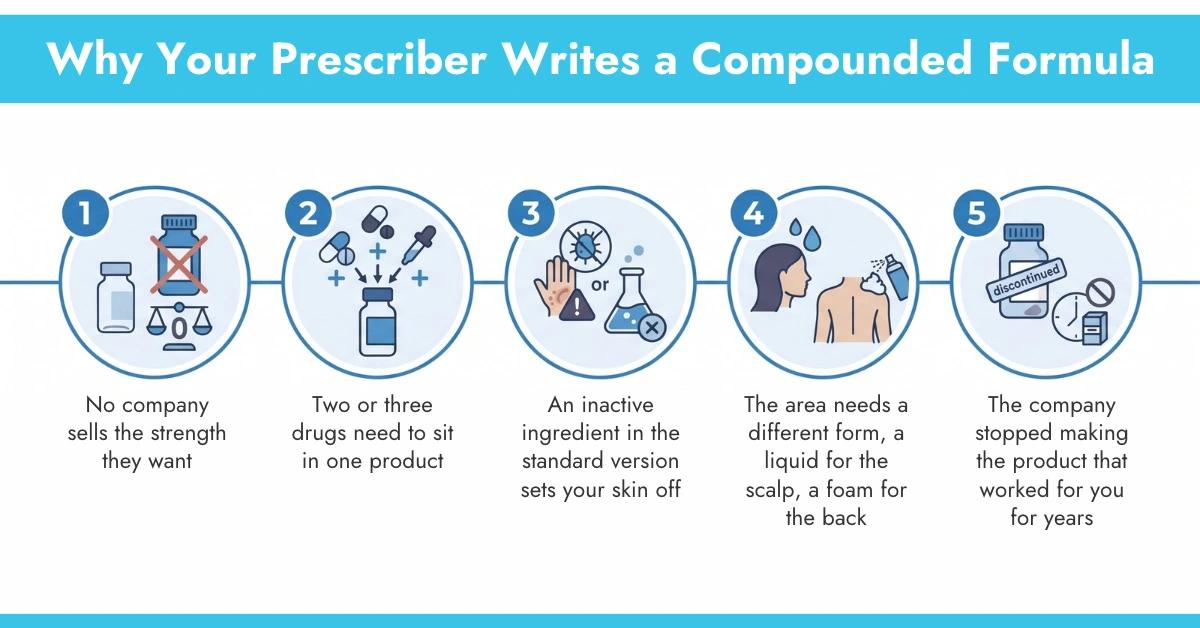
Standard drugs fit most people. Compounding exists for the ones they don’t fit. Prescribers write for it when:
- No company sells the strength they want
- Two or three drugs need to sit in one product
- An inactive ingredient in the standard version sets your skin off
- The area needs a different form, a liquid for the scalp, a foam for the back
- The company stopped making the product that worked for you for years
None of that comes down to preference. It comes down to what your skin will tolerate. Whether a customized topical medication suits you is your prescriber’s call, not something to arrange on your own.
We take the same view across the whole pharmacy: matching drugs to the person standing in front of us, not to an average.
Is It FDA-Approved? Who Regulates It?
No. The FDA does not approve compounded medications as finished products.
Three sets of rules cover the work instead:
- Federal law: Section 503A of the FD&C Act sets the conditions that let a pharmacy compound for one patient.
- State boards: Your state board of pharmacy licenses and inspects the pharmacy. In Texas, that means the Texas State Board of Pharmacy.
- Quality standards: USP <795> covers non-sterile compounding, which is what most skin preparations are.
Rules tightened for a reason. In 2012, contaminated injections from one compounding facility caused a fungal meningitis outbreak, and Congress passed the Drug Quality and Security Act in 2013. The FDA spells out the current rules on its human drug compounding page.
Compounded vs. Manufactured, Side by Side
Manufactured | Compounded | |
FDA review | Approved as a finished product | Not reviewed as a finished product |
Made for | Thousands of patients | One patient, one prescription |
Strength and form | The company decides | Your prescriber decides |
Insurance | Usually covered | Usually paid out of pocket |
Neither column is better. They’re different tools, and your prescriber picks.
What It Costs, and Why Insurance Says No
Most people pay cash. Health plans and pharmacy benefit managers rarely cover compounded prescriptions, and their rules have tightened over the last several years.
A plan will sometimes look at one. You have to show an allergy to an inactive ingredient that appears in every commercial version, or your prescriber has to document that the compounded form is needed. Even then it runs through prior authorization, and approval isn’t a promise.
Your price depends on the formula how many drugs, what strength, what amount, which base. Ask three things before anything gets mixed:
- Does my insurance cover this?
- What’s the cash price?
- Would a change in the formula change the price?
Cost isn’t a small matter. A 2020 study in the Journal of the American Academy of Dermatology found that price affected whether patients stayed on a retinoid at all. A refill you can’t afford treats nothing.
Four Things Nobody Tells You Before You Pay
A compounded medication usually can’t be returned or refunded. Once a pharmacist prepares for you, it can’t go back in the jar or onto a shelf for somebody else.
- Ask the price before you say yes, not after you’ve paid.
- The same formula costs different amounts at different pharmacies.
- Your cream may look or smell a little different at each refill. Hand-mixed preparations vary between batches a shade lighter, slightly thicker. Somebody made this in small amounts, not on a factory line. That’s normal. Gritty texture or a strange color shift is what deserves a phone call.
- The date on the label isn’t an expiration date. It’s a beyond-use date, how long the preparation holds once mixed, and it’s shorter than you’d guess. Respect it, and don’t tuck a half-used jar away for next winter.
Mistakes We See With Compounded Topicals
- Using more than prescribed to speed things up. It doesn’t work that way, and irritation follows.
- Stacking it with over-the-counter acids, retinol, or vitamin C without asking. Check before you layer.
- Quitting a retinoid during the adjustment weeks, right as your skin starts to settle.
- Skipping sunscreen while treating dark spots. Your treatment can’t outrun the sun.
- Assuming your prescriber sent the order somewhere that compounds. Plenty of pharmacies don’t.
If your skin reacts badly, call your prescriber or your pharmacist. Don’t improvise.
How to Pick a Compounding Pharmacy
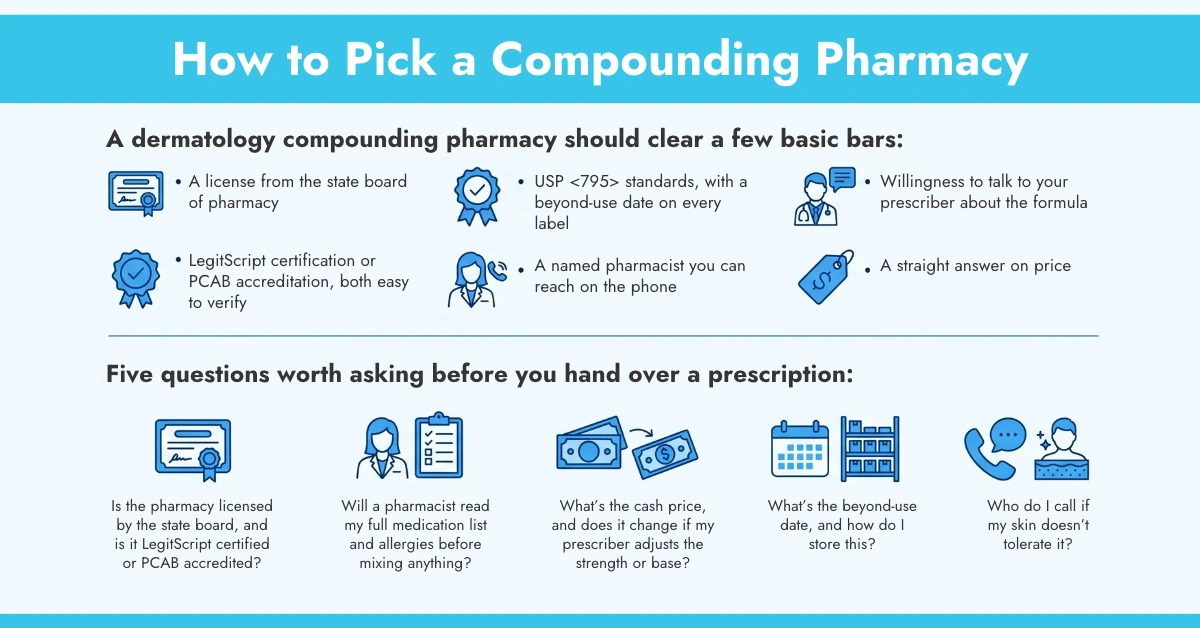
A dermatology compounding pharmacy should clear a few basic bars:
- A license from the state board of pharmacy
- LegitScript certification or PCAB accreditation, both easy to verify
- USP <795> standards, with a beyond-use date on every label
- A named pharmacist you can reach on the phone
- Willingness to talk to your prescriber about the formula
- A straight answer on price
Five questions worth asking before you hand over a prescription:
- Is the pharmacy licensed by the state board, and is it LegitScript certified or PCAB accredited?
- Will a pharmacist read my full medication list and allergies before mixing anything?
- What’s the cash price, and does it change if my prescriber adjusts the strength or base?
- What’s the beyond-use date, and how do I store this?
- Who do I call if my skin doesn’t tolerate it?
Conclusion
The word compounded threw you off, and that’s fair. Nobody at the counter hands you a pamphlet explaining it. Ask yourself what is dermatology compounding now, and you can answer without help, a pharmacist builds your medication by hand from your prescriber’s instructions. State boards watch the work, and you have five questions to ask before you pay. Uptown Pharmacy makes these medications in its Oak Lawn pharmacy in Dallas.
Medical Disclaimer:
This article gives general information, not medical advice. It draws on FDA, USP, and Texas State Board of Pharmacy sources. AI assisted with drafting and editing. Images are AI generated. Ask your prescriber before changing any medication.


