

A pharmacy shelf holds one strength, one flavor, and one form of each drug. Personalized medicine exists for every patient a standard bottle doesn’t fit: the child who won’t swallow a tablet, the person allergic to a specific dye or filler, the hormone therapy patient who needs a dose no manufacturer sells.
Uptown Pharmacy, a licensed compounding pharmacy near Dallas’s Turtle Creek, builds each of these prescriptions by hand in a USP-certified lab, under a valid prescription from your provider. Below: Who actually needs a compounded medication, what our pharmacists can make, and how to start.
What Is Personalized Medicine?
Personalized medicine, in a pharmacy setting, means changing a medication’s strength, form, or ingredients so it fits one specific patient instead of the mass-produced version. A compounding pharmacist does this by hand-preparing the prescription from raw, pharmaceutical-grade ingredients, exactly as your provider ordered it.
Common changes include:
- Strength: A dose between the fixed strengths a manufacturer sells.
- Form: Turning a tablet into a liquid, cream, chewable, or troche.
- Ingredients: Removing a dye, gluten, or preservative you’re allergic to.
- Combination: Merging two or more medications into a single dose.
- Availability: Recreating a medication that’s discontinued or on backorder.
The FDA is direct about who compounding is for: compounded drugs should only be used in patients whose medical needs can’t be met by an FDA-approved product, a dye allergy or a child who can’t swallow a capsule, for example, not general preference.
Who Can Benefit From Personalized Medicine?
Most patients who need compounding fall into a handful of clear situations. If you recognize yourself on this list, a conversation with a compounding pharmacist is worth having.
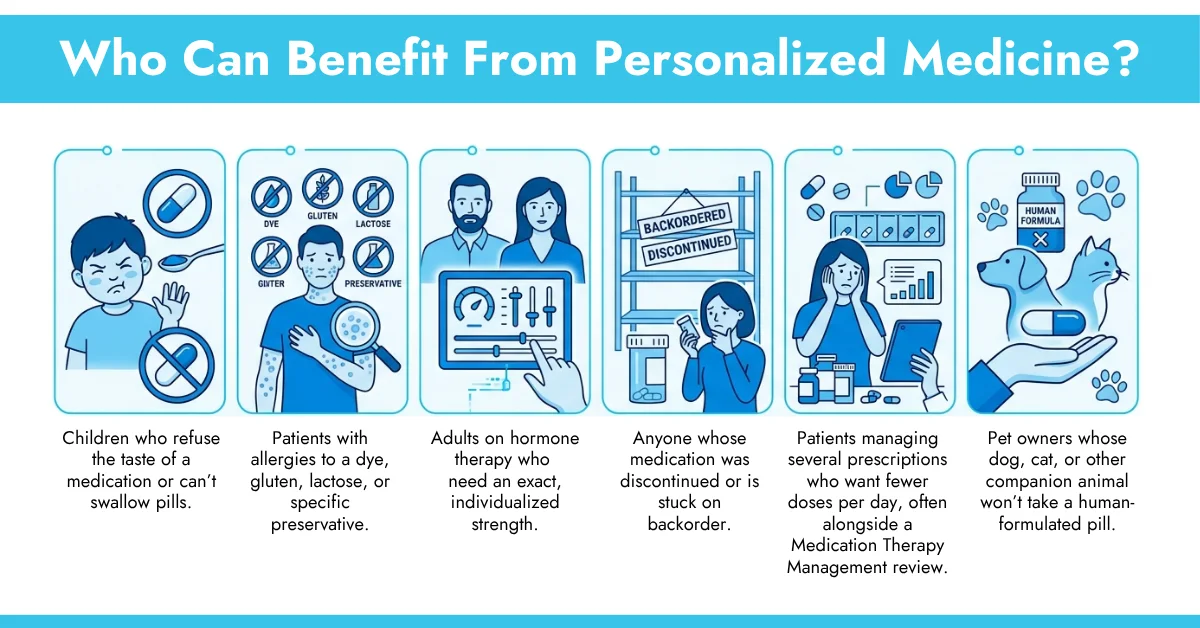
- Children who refuse the taste of a medication or can’t swallow pills.
- Patients with allergies to a dye, gluten, lactose, or specific preservative.
- Adults on hormone therapy who need an exact, individualized strength.
- Anyone whose medication was discontinued or is stuck on backorder.
- Patients managing several prescriptions who want fewer doses per day, often alongside a Medication Therapy Management review.
- Pet owners whose dog, cat, or other companion animal won’t take a human-formulated pill.
Compounded prescriptions make up a small share of the market, an estimated 1% to 3% of all U.S. prescriptions, because most patients don’t need one. The ones who do usually know it already: a standard bottle simply hasn’t worked.
What Can Uptown Pharmacy’s Compounding Lab Make for You?
Our pharmacists compound prescriptions across several categories, each solving a different version of the same problem: a standard drug that doesn’t fit.
- Hormone Replacement Therapy (BHRT).
- Pain Management Compounds.
- Dermatology Preparations.
- Pediatric Compounding.
- Veterinary Compounding.
- Thyroid Medication Compounding.
- Allergen-Free Formulations.
Compounded medications are prepared for one patient under one prescription, so they’re not FDA-approved the same way mass-manufactured drugs are a distinction the National Academies’ review of compounded BHRT covers in detail. That’s why every compound at Uptown Pharmacy starts with a physician’s order and a pharmacist review.
Is Compounded Medication Safe? What Standards Protect You?
Yes, when it’s prepared by a licensed pharmacy following recognized compounding standards. Uptown Pharmacy’s lab is built around USP <795> and <797>, the national standards covering personnel training, ingredient quality, and facility cleanliness for compounding pharmacies.
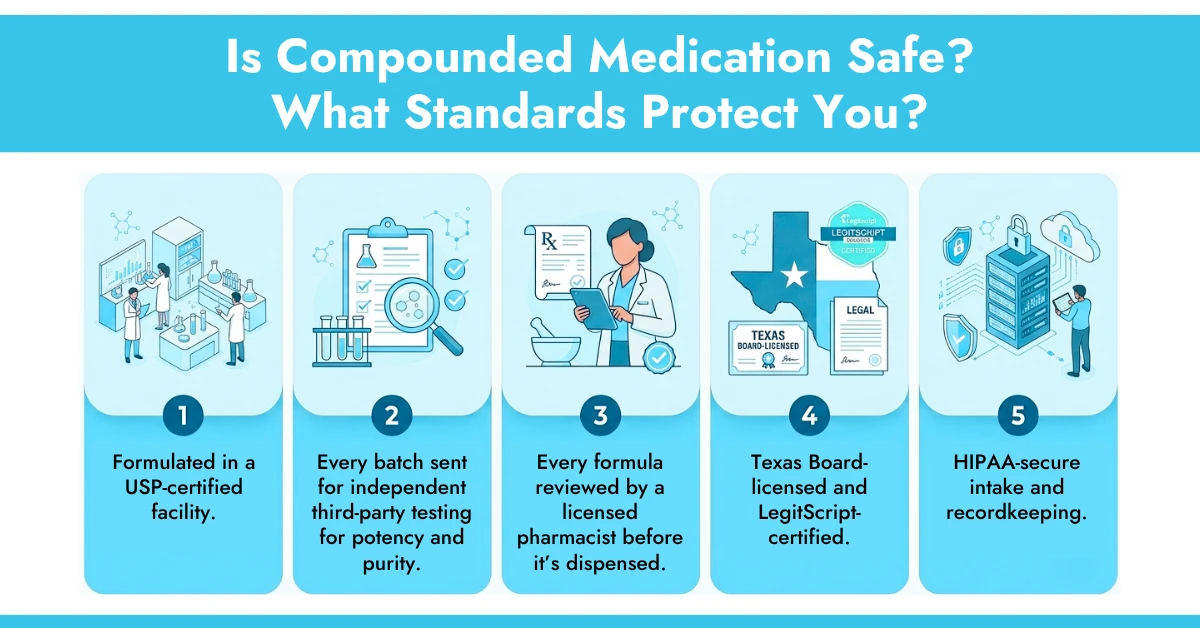
- Formulated in a USP-certified facility.
- Every batch sent for independent third-party testing for potency and purity.
- Every formula reviewed by a licensed pharmacist before it’s dispensed.
- Texas Board-licensed and LegitScript-certified.
- HIPAA-secure intake and recordkeeping.
The FDA doesn’t verify a compounded formula’s safety, effectiveness, or quality before it reaches a patient that review simply doesn’t exist for compounded drugs the way it does for manufactured ones. That’s why the standards above matter: Ask any compounding pharmacy whether it follows USP <795>/<797> and uses third-party batch testing, and the answer tells you most of what you need to know before filling a prescription there.
Can Compounding Help a Pet Who Won’t Take Its Medicine?
Yes. Veterinary compounding turns a pill your dog or cat refuses into a flavored liquid, chew, or transdermal gel, built from your veterinarian’s prescription.
- Flavored liquids or chews for cats and dogs that spit out pills.
- Custom strengths sized for small breeds, kittens, or exotic pets.
- Transdermal gels for animals that fight oral dosing.
- Requires a veterinarian’s prescription, exactly like any compounded medication.
This is one of the more overlooked uses of compounding; most pharmacy content covers people and skips pets, even though the same lab, the same USP standards, and the same pharmacist review apply.
Will Insurance Cover a Compounded Prescription?
Sometimes, but not automatically. Coverage depends on your plan, the ingredients used, and whether the compound is documented as medically necessary, not just preferred.
- Some plans cover the base prescription but not the compounding fee.
- Others exclude compounded medications from coverage entirely.
- Many patients pay out of pocket, especially for BHRT or specialty formulations.
- Uptown Pharmacy’s team can check your specific benefits before you order.
Compounding coverage varies more than standard prescription coverage does. Ask before you order, not after.
How Do You Start a Compounded Prescription at Uptown Pharmacy?
Every compounded prescription starts the same way: Your provider writes an order specifying the formulation, and Uptown Pharmacy prepares it to those exact instructions, ready for pickup in-store or delivery to your door.
- New patient? Complete the new patient form.
- Already have a prescription elsewhere? Transfer it in a few minutes.
- Questions about a specific formulation first? Contact our pharmacists directly.
- Want the full list of formulations? Visit our compounding services page.
Conclusion:
A standard prescription works for most people, most of the time. When it doesn’t an allergy, a child who won’t take the medicine, a hormone dose that needs adjusting, a pet who fights every pill Uptown Pharmacy’s compounding lab is built to solve exactly that problem, one prescription at a time.
Disclaimer:
This content is educational and doesn’t replace individual advice from your provider or pharmacist. Compounded medications require a valid prescription and, unlike mass-manufactured drugs, aren’t FDA-approved.


