

NAD+ for recovery has gained attention among athletes and active adults looking for less muscle soreness and faster recovery after exercise. NAD+ plays an important role in cellular metabolism, but current human research has not established that NAD+ products reliably reduce post-workout soreness or speed muscle repair in healthy adults.
Studies of related compounds, such as NMN and NR, do not prove that direct NAD+ capsules, troches, or IV therapy provide the same benefits.
What Does Recovery Mean After Exercise?
Recovery can mean different things depending on your training goals. A product that affects one outcome may not improve another.
Recovery goal | What it means |
Reduced discomfort after exercise | |
Less fatigue | Feeling less tired after a workout |
Restored strength | Regaining force and muscle function |
Better endurance | Maintaining performance during exercise |
Injury recovery | Healing damaged tissue and restoring function |
These outcomes matter when evaluating research. For example, a study that measures running performance does not automatically show that a supplement reduces next-day soreness.
What Are NAD+, NMN, and NR?
These compounds are related, but they are not interchangeable.
- NAD+ (nicotinamide adenine dinucleotide): A coenzyme that helps cells carry out metabolic processes and produce usable energy.
- NMN (nicotinamide mononucleotide): A compound the body can use to produce NAD+.
- NR (nicotinamide riboside): Another NAD+ precursor that supports the body’s NAD+ production pathways.
The difference matters because researchers test specific ingredients, formulations, and routes of administration. A study of oral NMN cannot establish that a direct NAD+ product will deliver the same results.
Products may come as oral supplements, compounded preparations, or formulations intended for administration through the mouth or bloodstream. Their evidence and safety profiles can differ.
Does NAD+ for Recovery Help? What Human Studies Show
Human studies provide some useful information about NAD+ precursors and exercise. They do not yet establish a reliable recovery benefit from direct NAD+ products.
Study | What researchers tested | Main finding | What it means for recovery |
2021 runner trial | Some submaximal exercise measures improved in medium- and higher-dose groups. VO₂max and peak power did not show the same benefit. | The study did not establish less soreness or faster muscle repair. | |
2022 muscle-injury trial | The combination did not significantly improve measured muscle-recovery outcomes after experimentally induced injury. | Raising NAD+-related measures does not guarantee better recovery. | |
2022 evidence review | Research on NAD+ therapeutics and exercise | Available evidence did not support improved exercise adaptation or athletic performance in healthy humans. | More research is needed to establish meaningful benefits. |
What should you take away from these studies?
The main issue is the gap between what people want to improve and what researchers have tested.
- Want less soreness the morning after lifting? The NMN runner trial did not establish that benefit.
- Want to regain strength faster after a hard workout? The NR combination trial did not show a significant improvement in measured recovery outcomes.
- Want better endurance? The NMN trial found improvements in some exercise measures, but not across every performance measure.
These findings do not prove that every NAD+-related product is ineffective. They show that the available evidence does not support broad claims about faster workout recovery.
Does the Route Matter: Oral Supplements, Troches, or IV?
You may see several options marketed for NAD+ recovery support, including oral supplements, compounded lozenges, and intravenous infusions. It is reasonable to ask whether one option works better than another.
The problem is that researchers have not established which delivery route, if any, provides the best results for exercise recovery.
Here is how to understand the main options:
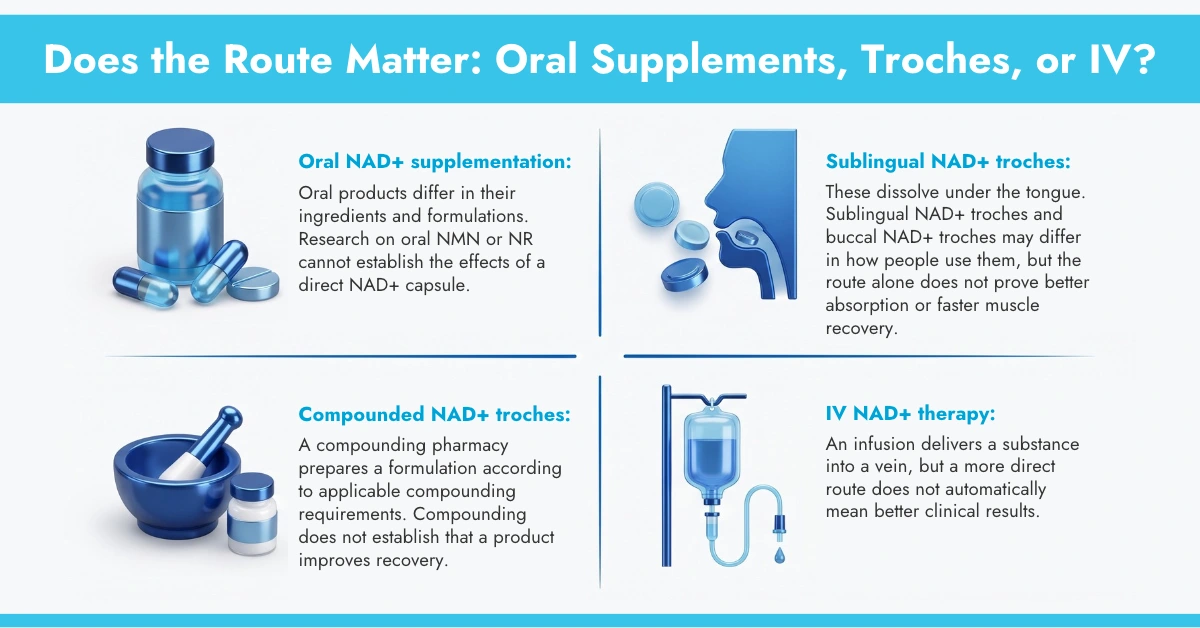
- Oral NAD+ supplementation: Oral products differ in their ingredients and formulations. Research on oral NMN or NR cannot establish the effects of a direct NAD+ capsule.
- Sublingual NAD+ troches: These dissolve under the tongue. Sublingual NAD+ troches and buccal NAD+ troches may differ in how people use them, but the route alone does not prove better absorption or faster muscle recovery.
- Compounded NAD+ troches: A compounding pharmacy prepares a formulation according to applicable compounding requirements. Compounding does not establish that a product improves recovery.
- IV NAD+ therapy: An infusion delivers a substance into a vein, but a more direct route does not automatically mean better clinical results.
A 2026 systematic review examining NAD+ supplementation for anti-aging and wellness reported no eligible IV or intramuscular NAD+ clinical outcome trials for those indications. This was not an exercise-recovery review, so it cannot settle the question of whether IV NAD+ helps athletes recover faster.
Safety Questions to Ask Before Choosing a Product
Before considering an NAD+-related product, get clear answers to these questions:
- What is the exact ingredient? Confirm whether the product contains NAD+, NMN, NR, or a combination.
- How is it administered? Oral supplements and injectable preparations have different considerations.
- Is it a dietary supplement or a compounded drug? These categories have different regulatory requirements.
- What evidence supports the intended benefit? Ask whether human studies tested the same ingredient, route, and recovery outcome.
- Who oversees its use? Discuss relevant health conditions, medications, and product-specific risks with a qualified healthcare professional.
The FDA explains that compounded drugs are not FDA-approved and are not reviewed by the agency for safety, effectiveness, or quality before marketing. Compounding can meet specific medical needs, but the product and its preparation still matter. Read the FDA’s guidance on the risks of compounded drugs.
What about injectable NAD+?
The FDA has warned compounders against using food-grade NAD+ ingredients to prepare sterile injectable products without appropriate processing. Such ingredients may carry a risk of microbial and endotoxin contamination.
The agency has received reports of adverse reactions following NAD+ injections, including severe chills, shaking, vomiting, and fatigue. Some people required medical treatment.
This warning concerns specific ingredient and sterile-compounding risks. It does not mean every compounded preparation has the same risk, but it makes product sourcing and preparation important questions to discuss with a qualified professional.
Common Mistakes When Evaluating NAD+ Recovery Products
Marketing claims can make the evidence seem stronger than it is. Watch for these common mistakes:
- Confusing biomarkers with results: A rise in NAD+-related blood measures does not prove faster recovery.
- Treating precursors as direct NAD+: NMN and NR findings cannot establish the effects of a direct NAD+ product.
- Mixing up outcomes: Less soreness, restored strength, improved endurance, and injury healing are different goals.
- Assuming IV means better: A delivery method does not establish clinical effectiveness.
- Ignoring basic recovery habits: Training-load management, adequate sleep, sufficient food, and hydration remain important parts of a sensible recovery routine.
Before choosing a product, ask yourself one question: Has a human study tested this exact ingredient and route in a relevant population and measured the outcome I want? If the answer is no, treat the claimed benefit as uncertain rather than established.
Conclusion
Although NAD+ plays an important role in cellular energy production, research has not yet established that it reduces muscle soreness or speeds workout recovery. At Uptown Rx Pharmacy, accurate information about NAD+ starts with understanding what the evidence supports and what remains uncertain.
Medical Disclaimer:
This article is for educational purposes only and does not replace professional medical advice, diagnosis, or treatment. Consult a qualified healthcare professional before using NAD+ products.


