

Type “benefits of peptide therapy” into Google and two kinds of pages show up: ones promising a miracle in a vial, and ones full of lab jargon nobody asked for. Neither answers the real question, which peptides actually work, which ones are legal right now, and which ones are just a well-marketed research chemical with your name on the shipping label.
Peptides are short chains of amino acids that direct specific jobs in your body, from digestion to tissue repair, and lab-made versions copy or boost those jobs on purpose.
Uptown Pharmacy’s compounding pharmacists field these questions weekly. Here’s the straight version.
What Are Peptides, Exactly?
Peptides are short chains of amino acids, the same building blocks as protein, just fewer of them linked together (usually under 50). Your body already runs on them: insulin is technically a peptide, and so is the collagen your skin depends on.
- Peptide vs. protein: proteins are long, folded chains; peptides are shorter fragments that absorb and act faster.
- Natural peptides regulate blood sugar, hormone signaling, and tissue repair.
- “Peptide therapy” means using a lab-made peptide to target one of those jobs on purpose, usually by injection or a prescribed topical.
What Are the Real Benefits of Peptide Therapy for Weight & Muscle?
The best-documented peptides in this category are GLP-1 medications: Semaglutide and tirzepatide are both peptides, both FDA-approved, for weight management and blood sugar control under brand names like:
- Wegovy.
- Ozempic.
- Zepbound.
- Mounjaro.
Peptides marketed specifically for muscle growth and fat loss, growth hormone secretagogues such as CJC-1295 and ipamorelin, are popular in gym culture but carry far less human safety data and tighter legal limits.
- Are GLP-1s peptides? Yes, semaglutide and tirzepatide are both peptide-based drugs with full FDA approval for specific uses.
- Compounded (non-brand) semaglutide and tirzepatide are now limited to patients with a documented medical need, since the FDA declared the national shortage resolved.
- Peptides for weight loss aren’t chemically different for women, candidacy and dosing depend on individual labs and history, which is why a prescription and pharmacist review matter more than the marketing.
Can Peptides Help With Healing, Inflammation, or Skin?
Some peptides are studied for tissue repair; others are established, regulated skin-care ingredients. BPC-157 and TB-500 are the two names you’ll see most for healing and anti-inflammatory use, but neither is an FDA-approved drug, and their compounding status has flipped twice in 2026 alone. Collagen peptides, by contrast, are a well-established supplement category sold over the counter.
- BPC-157 was restricted from pharmacy compounding in 2023 over safety data gaps, removed from that restricted list in April 2026, and is now under formal FDA review that could allow limited prescription compounding again; nothing is finalized yet.
- Anyone searching “bpc 157 peptide where to buy” should know most online sellers label it “research use only,” meaning it’s untested and unregulated for injection into a person.
- Oral and topical collagen peptides support skin elasticity and joint comfort, a supplement claim, not a disease claim, since the FDA hasn’t evaluated collagen for treating any condition.
|
Peptide category |
What it’s used for |
Where it stands (verify before you rely on this) |
|
Semaglutide, tirzepatide |
Weight management, blood sugar |
FDA-approved brand drugs; compounding limited to documented medical need |
|
Bremelanotide (PT-141) |
Low sexual desire |
FDA-approved as Vyleesi for HSDD in premenopausal women |
|
BPC-157, TB-500 |
Tissue and gut healing, recovery |
Not FDA-approved; under active FDA review for compounding eligibility |
|
Collagen peptides |
Skin, joints |
Regulated as a dietary supplement, not a drug |
|
CJC-1295, ipamorelin, sermorelin |
Growth-hormone support, muscle |
Not FDA-approved; compounding restricted; banned in competitive sports |
How Is Peptide Therapy Actually Taken?
Most therapeutic peptides are given by injection, because stomach acid breaks down oral peptides before they can work. A handful of peptide pills exist, but “peptide supplements” sold as capsules are almost always collagen or very small fragments, not the same as prescription-strength peptide therapy.
- Subcutaneous injection is the standard route for compounded or FDA-approved peptides.
- Can you do peptides without needles? A few, like collagen and select nasal-spray formulations, if a seller claims a needle-free version of an injectable-only peptide, treat that as a warning sign.
- Dose and frequency should come from your prescriber, not a forum thread.
Is Peptide Therapy Safe?
Short version: FDA-approved peptides carry a documented, monitored safety profile; unregulated ones don’t, and that gap is where most real risk sits.
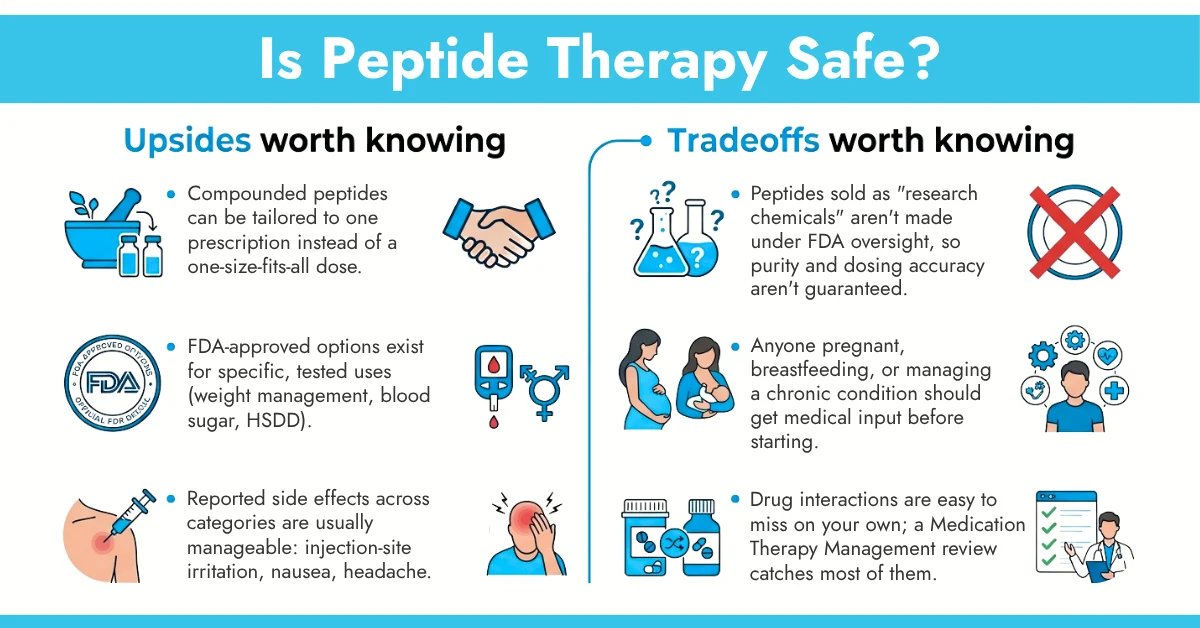
Upsides worth knowing:
- Compounded peptides can be tailored to one prescription instead of a one-size-fits-all dose.
- FDA-approved options exist for specific, tested uses (weight management, blood sugar, HSDD).
- Reported side effects across categories are usually manageable: injection-site irritation, nausea, headache.
Tradeoffs worth knowing:
- Peptides sold as “research chemicals” aren’t made under FDA oversight, so purity and dosing accuracy aren’t guaranteed.
- Anyone pregnant, breastfeeding, or managing a chronic condition should get medical input before starting.
- Drug interactions are easy to miss on your own; a Medication Therapy Management review catches most of them.
Are Peptides Legal? Do You Need a Prescription?
It depends entirely on which peptide. Some, like semaglutide, are FDA-approved prescription drugs. Others can be legally compounded by a licensed pharmacy once a physician writes a valid prescription and the peptide sits on the FDA’s approved compounding list. Plenty of peptides sold online, most “research use only” vials included, aren’t legal for human use no matter how easy they are to buy.
- Are peptides steroids? No. Steroids are built from a cholesterol-based ring structure; peptides are amino acid chains. They’re regulated differently and act through different pathways, even though both show up in performance contexts.
- Do peptides show up on drug tests? Standard workplace panels don’t screen for peptides. Competitive athletes are the exception: the World Anti-Doping Agency bans BPC-157, TB-500, CJC-1295, ipamorelin, and most growth-hormone-related peptides at all times, in and out of competition.
- What FDA-approved changes are; what a compounding pharmacy can legally prepare changes even more; confirm both before assuming a peptide is available.
Where Should You Actually Start Peptide Therapy?
The peptide’s name matters less than where it comes from. A licensed pharmacy compounds under a physician’s prescription, with lab-tested ingredients and a pharmacist checking your other medications first. An unregulated website selling “research use only” vials offers none of that; you’re the one carrying the risk if something is mislabeled or contaminated.
Uptown Pharmacy’s compounding pharmacists walk this exact process with patients: a consultation, a valid prescription from your provider, compounding in an FDA-registered facility, and delivery with pharmacist follow-up.
Conclusion:
Peptide therapy isn’t one product with one answer. It ranges from FDA-approved medication available at any pharmacy to untested vials from a website with no license number in sight. The FDA’s own compounding rules for peptides like BPC-157 and TB-500 have shifted twice in 2026 alone, so “current” is doing a lot of work in that sentence.
Disclaimer:
This article is for education, not a substitute for individualized medical advice. Talk to a licensed provider before starting any peptide regimen, especially given how often the legal status of specific peptides is changing in 2026.


