

DALLAS: Six peptides just got a new path to the pharmacy counter. Maybe. Under the new HHS peptide policy, HHS says it will not take enforcement action against qualifying state-licensed pharmacies, federal facilities or licensed physicians that compound BPC-157, Epitalon, KPV, MOTS-c, Semax and TB-500. Read that twice, because the fine print carries the story.
The policy does not grant FDA approval or establish clinical safety and effectiveness. You still need a prescription. Your pharmacy still has to clear a long list of hurdles. Here’s what happened, what it means for HHS peptide policy patient access in Texas, and how to avoid getting burned.
What the New HHS Peptide Policy Actually Does
HHS calls its move enforcement discretion. Translation: the agency will look the other way, under conditions, instead of rewriting the law. That FDA enforcement discretion peptides approach grew out of a July 2026 meeting of FDA’s Pharmacy Compounding Advisory Committee and the administration’s stated interest in expanding patient access. The stated goal? Give patients a more controlled alternative to unregulated research-use-only sellers.
Pharmacies that offer compounded peptide therapy now have a federal checklist to follow, and it gets specific about routes:
Peptide | Permitted routes |
BPC-157 | Subcutaneous, intramuscular, oral, topical |
TB-500 | Subcutaneous, intramuscular |
Subcutaneous, intramuscular (intermittent courses) | |
MOTS-c | Subcutaneous, intramuscular |
KPV | Topical, oral |
Semax | Intranasal |
The Rules Pharmacies Must Follow
The HHS peptide policy 2026 is no free pass. Think of it as a checklist with teeth. Pharmacies must meet 10 conditions, and those conditions reshape 503A peptide compounding from here on. The big ones:
- Prescription: One patient, one valid prescription.
- One peptide per product: A blend like BPC-157 plus TB-500 falls outside the policy.
- Source: The peptide must come from an FDA-registered manufacturer that follows current good manufacturing practice.
- Paperwork: The pharmacy needs certificates of analysis covering identity, purity, potency and contaminants.
- Reporting: Serious adverse events and product-quality problems go to FDA’s MedWatch program.
- Label: Every product must carry a statement that it is a compounded drug product, not for resale.
The full text lives in the Federal Register notice.
What Did Not Change
Headlines make this sound bigger than it is. Peptides did not suddenly become legal and approved. FDA has approved none of the six.
The policy also leaves the 503A bulks list untouched. It only pauses enforcement while FDA runs a rulemaking that could take 12 to 24 months. So the question behind 503A bulks list peptides stays wide open. Other FDA peptide regulations haven’t moved an inch, either. The FDA peptide compounding policy still blocks blends and covers only small 503A pharmacies, not large 503B outsourcing facilities. CJC-1295 and ipamorelin? Not included.
Online research chemical vials? Still outside the line. The policy covers pharmacies filling prescriptions, not websites selling vials. And the peptide a pharmacy uses has to match the exact chemical identities in the HHS policy appendix sequence, formula, even molecular weight.
Who Likes It, Who Doesn’t
The reaction split fast. The American Peptide Association applauded the draft but wants clarity on how it will work with state boards of pharmacy.
Skeptics point at the evidence, and they have a point. FDA reviewers said the BPC-157 studies were too small and too short to show safety or benefit. They found no human safety studies for KPV, TB-500, MOTS-c or epitalon. The American Medical Association warned that these peptides haven’t gone through the testing FDA-approved drugs require. NPR summed up the tension neatly: the policy doesn’t change their legal status, yet it opens a path for small compounders.
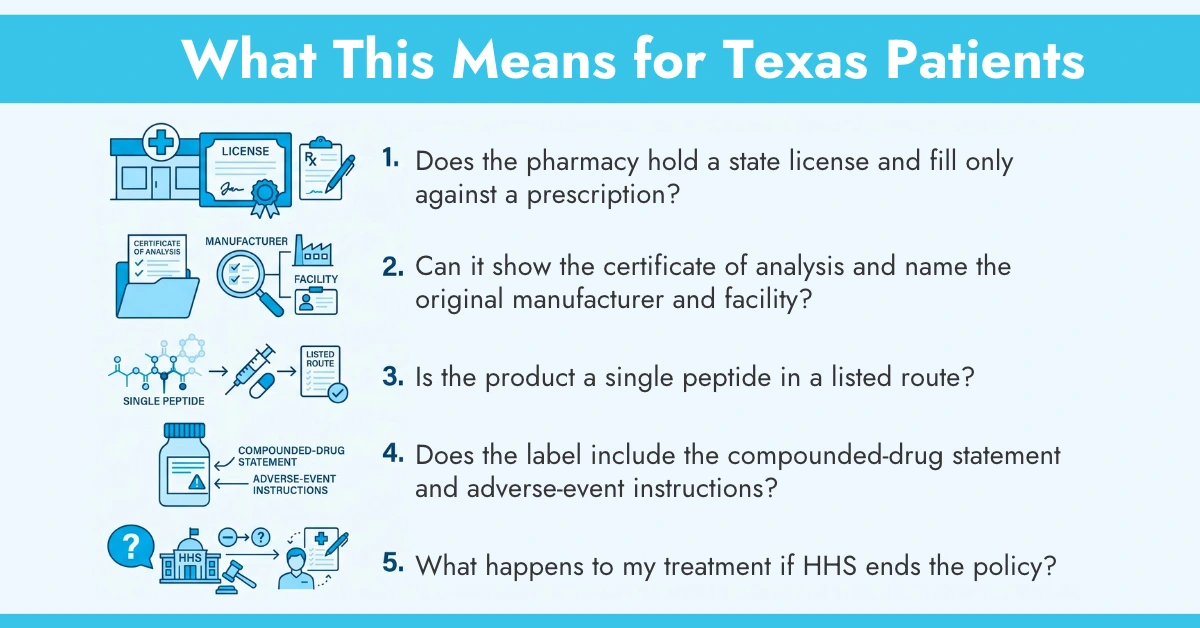
What This Means for Texas Patients
Federal discretion doesn’t override state law. The policy does not displace state pharmacy board requirements, and states already disagree. Ohio’s board, for one, still says BPC-157 can’t be compounded under state law. Texas pharmacies answer to the Texas State Board of Pharmacy, so ask your pharmacist how its rules touch your prescription.
Picture a website selling a BPC-157 and TB-500 blend with no prescription required. That product fails the policy three ways: two peptides in one vial, no prescription, and a seller instead of a licensed pharmacy. Easy call.
Before you fill anything, ask these questions:
- Does the pharmacy hold a state license and fill only against a prescription?
- Can it show the certificate of analysis and name the original manufacturer and facility?
- Is the product a single peptide in a listed route?
- Does the label include the compounded-drug statement and adverse-event instructions?
- What happens to my treatment if HHS ends the policy?
Three mistakes show up again and again. People read legal now as FDA-approved. They assume every state plays by the same rules, but compounded peptides regulations vary. And they expect insurance to help. Compounded drugs generally fall outside standard pharmacy benefit coverage, so patients would likely keep paying out of pocket.
Taking other medicines? A pharmacist can check for conflicts through medication therapy management before you add anything new.
What Happens Next
The clock is running. The notice publishes in the Federal Register on October 30, with public comments open for two weeks. FDA’s formal rulemaking follows. And HHS can pull back, since it says it may revisit the policy if safety signals or product-quality concerns arise. We’ll update this story as new details land.
Conclusion
The HHS peptide policy cracks a door open for six peptides narrowly, temporarily and with strings attached. It doesn’t prove these peptides work. It doesn’t make online vials safe. If you’re weighing a peptide prescription, talk it through with the pharmacists at Uptown Pharmacy before you commit.
Disclaimer: This article is for general information only and is not medical or legal advice. Peptides discussed are not FDA-approved. Consult a licensed healthcare provider or pharmacist before starting any treatment.


