

You eat reasonably well. You sleep close to eight hours and by 2 p.m. most days, you’re running on fumes anyway. If that sounds familiar, your hormones are worth a look before anything else. Estrogen, progesterone, cortisol, and thyroid hormone all rise and fall on their own schedules daily, monthly, and across life stages like perimenopause, and each one shapes how alert or drained you feel differently. This guide breaks down which hormone does what, why energy dips at predictable points in your cycle, and when fatigue is worth a real conversation instead of another cup of coffee.
Uptown Pharmacy’s pharmacists review medications and supplement routines for patients dealing with exactly this, every week.
What Hormone Makes You Tired & Which One Gives You Energy?
No single hormone runs your energy supply. Cortisol and thyroid hormone push you toward alertness, progesterone pulls you toward rest, and estrogen and testosterone sit in between, shaping mood and stamina rather than switching energy on or off.
Hormone | Effect on Energy | Worth Knowing |
Cortisol | Rises in the morning to wake you up, tapers off by night | Chronic stress can flatten this rhythm; it doesn’t “burn out” your adrenal glands |
Thyroid hormone (T3/T4) | Sets your baseline metabolic rate | An underactive thyroid is one of the most common medical causes of fatigue |
Estrogen | Supports serotonin, mood, and daytime alertness | Fatigue often shows up when levels drop sharply |
Progesterone | Mildly sedating and calming | Highest in the luteal phase and during pregnancy |
Testosterone | Contributes to stamina and motivation, in small amounts | Present in women too, just at much lower levels than in men |
Fatigue rarely traces back to one hormone acting alone. A drop in estrogen, a rise in progesterone, or an underactive thyroid can all produce the same flat, drained feeling — which is why guessing at a fix, like another supplement or more caffeine, so often misses the actual cause.
Does Progesterone Make You Tired?
Yes, progesterone is naturally sedating. Your body converts it into a compound called allopregnanolone, which acts on the same brain receptors as anti-anxiety medications, so higher progesterone reliably brings on more drowsiness.
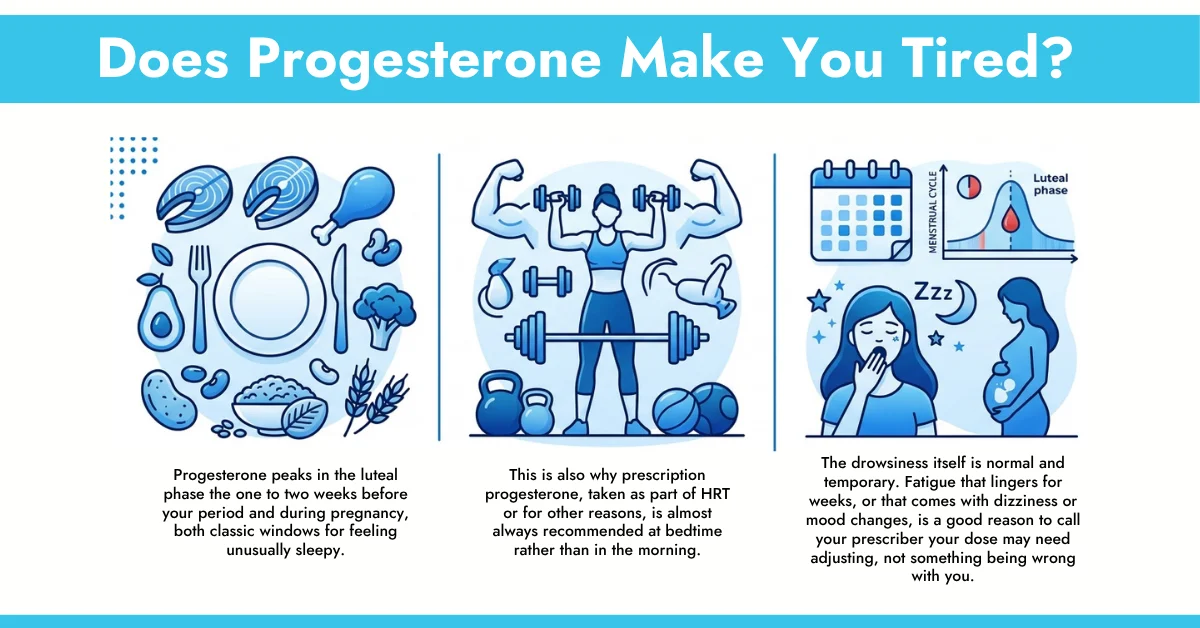
- Progesterone peaks in the luteal phase the one to two weeks before your period and during pregnancy, both classic windows for feeling unusually sleepy.
- This is also why prescription progesterone, taken as part of HRT or for other reasons, is almost always recommended at bedtime rather than in the morning.
- The drowsiness itself is normal and temporary. Fatigue that lingers for weeks, or that comes with dizziness or mood changes, is a good reason to call your prescriber your dose may need adjusting, not something being wrong with you.
Can Low Estrogen Cause Fatigue?
Yes. Low estrogen disrupts serotonin activity in the brain, and serotonin is a building block for melatonin so when estrogen drops, sleep quality and next-day energy tend to drop with it.
Cleveland Clinic lists fatigue as one of the lesser-recognized symptoms of low estrogen during perimenopause, alongside joint aches and dry skin symptoms people rarely connect back to hormones on their own. Estrogen dips happen predictably in the days before your period, more gradually across perimenopause, and abruptly after childbirth. Does estradiol give you energy directly? Not exactly steadier estradiol supports steadier serotonin, and that’s where the actual energy comes from.
Why Do You Feel Tired Around Ovulation & in the Luteal Phase?
Energy tends to run highest in the days leading up to ovulation, when estrogen is climbing, and lowest in the back half of the luteal phase, once progesterone takes over and estrogen falls.
- Follicular phase (day 1 to roughly day 14): estrogen rises and energy usually follows it up.
- Ovulation: a short estrogen and testosterone peak. Most people feel their sharpest here, though a smaller number notice a brief energy dip from the hormone shift itself.
- Luteal phase: progesterone rises for one to two weeks, bringing calmer, sleepier energy. Research published through the National Institutes of Health has even measured slightly higher resting energy expenditure during this phase, your body is working harder even when it feels like it’s running slower.
If your schedule allows it, save demanding workouts and big decisions for the week or two after your period, and build in lighter days before it.
Why Are You So Exhausted on Your Period?
Estrogen and progesterone both hit their lowest point right as your period starts, and prostaglandins the compounds behind cramping add inflammation on top. That combination produces real exhaustion, not just cramps.
- Blood loss plays a role too. A heavier flow can lower iron enough to cause anemia, which shows up as fatigue, dizziness, or shortness of breath.
- A light period paired with real fatigue deserves a mention at your next appointment — it can point to iron deficiency even without heavy bleeding, or to an unrelated thyroid issue.
- Fatigue that lingers well after your period ends, instead of lifting within a few days, is a signal to get checked rather than wait it out.
Is Fatigue a Sign of Perimenopause & Can HRT or Birth Control Help?
Perimenopause and Menopause
Fatigue is one of the most common perimenopause symptoms there is more common than most people expect. A Mayo Clinic-led global study published this year surveyed more than 12,000 people and found a real gap between expectation and reality: most people associate perimenopause with hot flashes, but among those actually going through it, upwards of 90% reported exhaustion and fatigue far more than the share who reported hot flashes.
Hot flashes and night sweats compound this by fragmenting sleep even when you don’t fully wake up, so eight hours in bed can still feel like four.
Does HRT give you energy? Not directly but by easing hot flashes and improving sleep, hormone therapy often leads to steadier daytime energy for people who are good candidates for it. It’s a decision made with a doctor, since HRT carries its own risks and benefits that differ from person to person.
Birth Control
Can birth control make you fatigued? Sometimes, though the evidence is genuinely mixed. Combined pills (estrogen plus progestin) are reported to cause fatigue more often than progestin-only methods, and response varies widely from person to person. If tiredness started right after switching methods, mention that timing at your next appointment a different formulation or lower dose sometimes clears it up.
How Do You Get Your Hormones Back in Balance?
There’s no single test or supplement that “balances hormones” on its own it’s less like flipping a switch and more like tuning several connected systems. The most useful first step is ruling out the common, fixable causes.
- Ask for a full medication review.
- Rule out the basics that mimic hormonal fatigue.
- Support your baseline before reaching for supplements.
- Check before you add anything new.
- Know when to loop in your doctor.
Conclusion:
Hormones move on their own timelines, daily, monthly, and across the decades, and some fatigue really is just part of that rhythm. Sorting out which pattern is yours doesn’t have to be a solo project. Talk with our pharmacists about your medications, supplements, or symptoms, or take a look at our full range of pharmacy services to see where to start.


