

Copper peptides have earned serious respect in the wellness world for skin repair and tissue regeneration, but subcutaneous injections are far from pleasant. Daily needles often leave stinging sensations, localized welts, and soreness. A ghk cu nasal spray bypasses the syringe entirely by delivering copper tripeptide-1 directly across the vascular nasal lining into the bloodstream.
This needle-free approach gives your body steady access to regenerative signaling peptides to support collagen synthesis, cellular defense, and tissue remodeling without the hassle of reconstitution or daily skin pricks.
What Is GHK-Cu Nasal Spray and How Does It Work?
GHK-Cu, also known as copper peptide, is a naturally occurring peptide made of three amino acids (glycyl-L-histidyl-L-lysine) bound to a copper ion. It is also used in formulations such as GHK-Cu Nasal Spray. Dr. Loren Pickart discovered it in human plasma back in 1973 when he noticed that plasma taken from young adults restored regenerative vitality to older liver tissue. Natural levels are highest in our youth, dropping by more than sixty percent by age sixty.
While topical serums only treat the skin’s surface, using a ghk cu peptide nasal spray introduces the molecule directly to your vascular system. The nasal lining contains a dense network of microcapillaries beneath a thin mucous barrier. GHK-Cu Nasal Spray is designed for nasal administration, offering a practical alternative to other delivery formats:
- Direct Mucosal Absorption: Active peptide molecules pass straight through the thin nasal epithelium into your bloodstream, bypassing digestive breakdown.
- No Digestive Breakdown: Oral peptide capsules rarely survive the stomach; harsh acids and proteolytic enzymes rapidly digest the amino acid chain into plain building blocks before it can work.
- Skips First-Pass Liver Metabolism: Absorbing the peptide through your nasal tissue avoids initial clearance by the liver, preserving higher systemic bioavailability than any oral tablet.
- Zero Injection Discomfort: A fine, metered mist delivers the compound smoothly, eliminating needle anxiety, bruised skin, and painful post-injection lumps.
To learn how different amino acid sequences work throughout the body, take a look at our guide explaining the benefits of peptide therapy.
What Does the Science Actually Say About GHK-Cu Benefits?
Much of the buzz around ghk cu nasal spray benefits mixes decades of human topical skincare research with recent animal trials. Let’s separate what has been proven in humans from what researchers are still exploring in preclinical studies.
Decades of laboratory and clinical research point to several distinct actions:
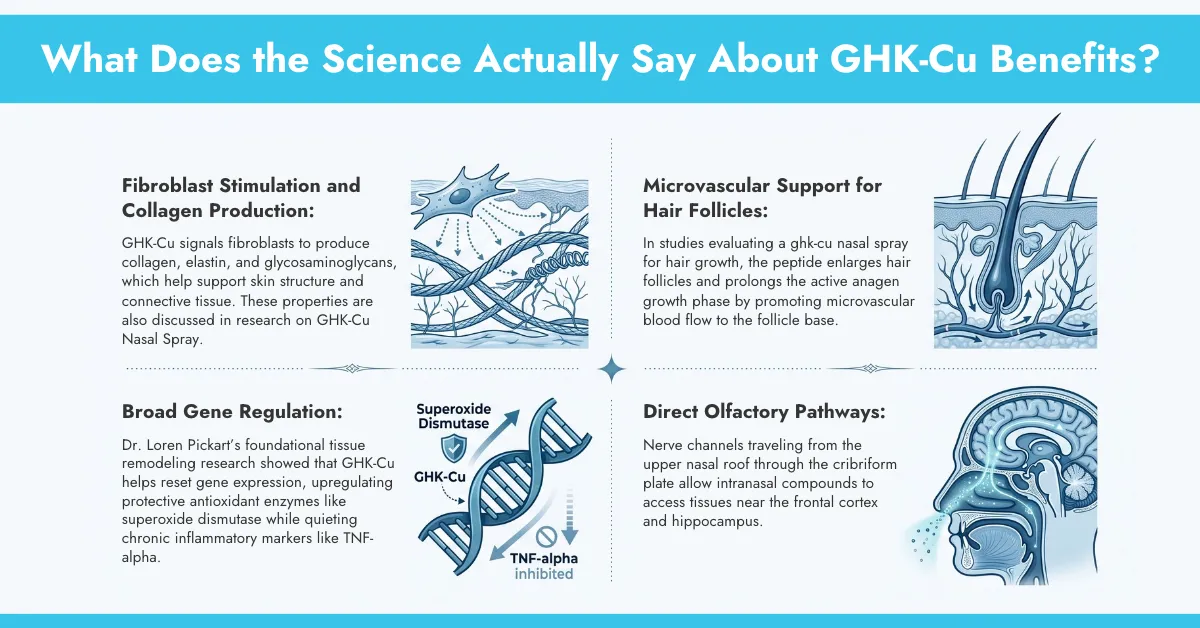
- Fibroblast Stimulation and Collagen Production: GHK-Cu signals fibroblasts to produce collagen, elastin, and glycosaminoglycans, which help support skin structure and connective tissue. These properties are also discussed in research on GHK-Cu Nasal Spray.
- Microvascular Support for Hair Follicles: In studies evaluating a ghk-cu nasal spray for hair growth, the peptide enlarges hair follicles and prolongs the active anagen growth phase by promoting microvascular blood flow to the follicle base.
- Broad Gene Regulation: Dr. Loren Pickart’s foundational tissue remodeling research showed that GHK-Cu helps reset gene expression, upregulating protective antioxidant enzymes like superoxide dismutase while quieting chronic inflammatory markers like TNF-alpha.
- Direct Olfactory Pathways: Nerve channels traveling from the upper nasal roof through the cribriform plate allow intranasal compounds to access tissues near the frontal cortex and hippocampus.
In a compelling preclinical study on aging mice published in Experimental Gerontology (2023), University of Washington researchers administered intranasal GHK-Cu to 20-month-old mice for sixty days. The treated mice navigated spatial mazes faster, showed better memory recall, and had noticeably lower neuroinflammatory markers than untreated mice.
Although these findings are encouraging, further human clinical trials are needed before GHK-Cu Nasal Spray can be considered an established brain therapy.
If you are curious about combining peptides with cellular cofactors, read article on what is NAD+ to see how cellular energy and signaling work side by side.
GHK-Cu Nasal Spray vs. Injections vs. Topical Serums
Each delivery route serves a distinct purpose depending on whether your goal is localized skin texture or whole-body tissue maintenance.
Feature | GHK-Cu Nasal Spray | Subcutaneous Injection | Topical Serum / Cream |
Primary Target | Systemic tissue repair & signaling | Whole-body systemic tissue recovery | Local dermis & surface skin |
Delivery Route | Vascular nasal mucosa | Adipose tissue via hypodermic needle | Outer skin barrier (stratum corneum) |
Preparation | Premixed ready-to-use solution | Requires mixing powder with bac water | Pre-formulated cosmetic bottle |
Needles Required? | No | Yes | No |
Comfort Level | High (gentle, painless mist) | Low (causes stinging and welts) | High (standard topical application) |
Systemic Uptake | Moderate to High | High (~100% bioavailability) | Negligible (stays localized) |
Comparing a GHK-CU Nasal Spray vs injection shows that while subcutaneous shots provide maximum systemic uptake, regular injection pain leads many people to quit early. A ghk-cu spray offers a comfortable, sustainable daily alternative.
How to Use GHK-Cu Nasal Spray: Dosage, Storage, and Technique
Using the right technique ensures the mist absorbs into the nasal lining instead of dripping down the back of your throat.
Dosing and Cycles
A standard 50mg bottle (10 mL) contains about 80 metered sprays, providing 625 mcg of peptide per spray.
- Daily Protocol: Most adults use 1 spray per nostril daily, totaling roughly 1,250 mcg of active peptide.
- Cycle Length: Practitioners generally recommend cycling for 4 to 8 weeks, followed by a 2- to 4-week break to let cellular receptors rest.
Proper Nasal Technique
- Clear your nose: Blow your nose gently first to clear away excess mucus.
- Keep your head level: Look straight ahead. Tilting your head back makes the liquid run straight into your throat.
- Aim outward: Insert the tip inside your nostril and angle it slightly toward the outer corner of your eye, keeping the stream off your sensitive nasal septum.
- Breathe in gently: Press down the pump while inhaling smoothly through your nose.Do not snort forcefully.
Storage Rules
Store your copper peptide nasal spray in the refrigerator between and ( – ). Heat and direct sunlight break peptide bonds down over time. Keep the protective cap on between uses to keep the pump clean.
If you want to understand how compounding pharmacies verify purity, read our breakdown on “Are compounded medications safe“.
Safety, Side Effects, and the Olfactory Question
Because this format enters through the nasal cavity, safety questions naturally come up.
Years ago, the FDA recalled certain zinc nasal sprays after reports of olfactory nerve damage and loss of smell. GHK-Cu Nasal Spray contains a chemically different peptide, but its nasal safety still requires clinical evaluation.
- Tightly Bound Organic Chelate: GHK-Cu binds copper within an organic peptide structure, unlike free metal ions. A 1,250 mcg dose contains approximately 170 mcg of copper, well below the NIH’s adult dietary upper limit of 10,000 mcg per day. However, dietary limits do not establish the safety of GHK-Cu Nasal Spray.
- Clean Animal Safety Records: Some studies examining high-dose intranasal GHK-Cu reported no damage to olfactory cells or smell receptors, though further human safety research is needed to establish the safety of GHK-Cu Nasal Spray.
Side Effects and Who Should Avoid It
Most people tolerate the spray easily, but minor issues can happen:
- Local Irritation: A brief tickle, dryness, or a sneeze right after spraying.
- Mild Metallic Taste: A temporary taste sensation if excess liquid drains past the nasal passage.
- Mild Headaches: Occasional frontal pressure, which usually clears when reducing the daily dose.
- Contraindications: Avoid copper peptides if you have Wilson’s disease, an active sinus infection, or a confirmed copper allergy. Consult your doctor if pregnant or nursing.
Conclusion
A nasal peptide spray offers a comfortable, needle-free path to systemic copper peptide therapy, giving you genuine tissue recovery and collagen support without daily injections. For a lab-tested, pre-mixed formulation prepared to strict purity standards, you can find our GHK-CU Nasal Spray directly in our pharmacy catalog.
Medical Disclaimer:
This article is for educational purposes only and does not provide medical diagnosis or treatment advice. Always speak with a licensed healthcare provider or pharmacist before starting any new peptide protocol.


